Magic Skittles Game
crayola supplies
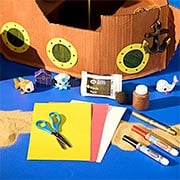
- Gel Markers
- Model Magic®
- No-Run School Glue
- Blunt-Tip Scissors
- Construction Paper
household supplies
- recycled cereal box
- toothpicks - wooden
- aquarium gravel
Why
It's always fun to go bowling! Make your own tabletop skittles game to play with friends and family.
Steps
- 1. To make the skittles (small bowling pins), use colored Crayola® Model Magic®. Roll a cylinder for the body of each skittle. Press the end of each cylinder against a flat surface until the cylinder stands upright. Make as many skittles as you want. The original game had nine pins.
- 2. To make the skittle heads, choose a contrasting color of Model Magic. Roll a ball of Model Magic for each head. Roll tiny balls and press on each head to make a nose and ears. Add a hat to match each body. Use a wooden toothpick to etch eyes and a mouth. Press each head onto a body. Glue together with Crayola School Glue.
- 3. With Crayola Scissors, cut bases for skittles from a recycled cereal box. Glue to each skittle. Dry.
- 4. To make a ball for your game, add aquarium gravel to Model Magic. Roll into a ball. Dry 24 hours.
- 5. Make a scoring mat, too. Use Crayola Gel Markers to draw numbered spaces for skittles on dark construction paper. Create your own bright designs.
- 6. Invite friends and family to play Magic Skittles with you!
When & Where
"Our children made skittles game sets for all their cousins. Their gifts were a real hit!"
- Aidan G., father of 6- and 7-year-olds.
"After-school kids made these games. They had fun competing in tournaments at our Community Day celebration."
- Duygu M., community center director.
Interesting Info
The game of skittles, or ninepin bowling, is many hundreds of years old. Pins were set up in a diamond formation and players threw the ball or 'cheese' at them. In the 19th century, some U.S. states passed laws against playing the game. To avoid breaking the law, lovers of the game simply added a tenth pin. As a result, today's popular game of bowling was created.
Safety Guidelines
Crayola Modeling Materials including Crayola Model Magic®, and Model Magic Fusion™, Crayola Air-Dry Clay, and Crayola Dough—
- Keep away from open flames. Do not use to make candleholders, hot plates, trivets, or other similar objects that will be used or placed near fire and other heat sources.
- Do not put in an oven, microwave, or kiln.
- Do not make into vessels/containers that will hold unpackaged food.
- The use of modeling material to make items that look like food is discouraged for children younger than age 5 to avoid their confusion with real food.
- Unless sealed with a water-resistant glaze, do not make projects exposed to or immersed in water, such as boats or outdoor bird feeders. They would disintegrate when exposed to moisture.
- Crayola Dough—contains gluten (wheat flour) as an ingredient.
- Crayola Air-Dry Clay, Crayola Model Magic and Model Magic Fusion are gluten-free. However, they are produced on the same machinery as Crayola Dough which does contain gluten. Although the machines are cleaned prior to the start of each production run, there is a slight possibility that trace amounts of gluten from Crayola Dough may be present in the other modeling compound products. For information regarding specific ingredients or allergic concerns, please call our Consumer Affairs department at 1-800-272-9652 weekdays between 9 AM and 4 PM Eastern Standard Time.
Modeling Tools—Use the least dangerous point or edge sufficient to do the job. For example, craft sticks, plastic knives and forks, and cookie cutters can cut or carve modeling materials.
Scissors—ATTENTION: The cutting edges of scissors are sharp and care should be taken whenever cutting or handling. Blunt-tip scissors should be used only by children 4 years and older. Pointed-tip scissors should be used only by children 6 years and older.
Wood—By its nature, wood is rough and may contain splinters or sharp points
© 2000 - 2006 Binney & Smith, Inc.