Pirate Treasure Hunt
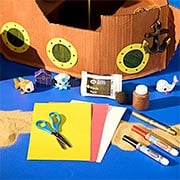
crayola supplies
- Markers
- Model Magic®
- Twistables®
- No-Run School Glue
- Blunt-Tip Scissors
- Construction Paper
household supplies
- modeling tools
- plastic dinnerware
Why
Children love adventures, especially when they create them. Children map out adventures as they make a treasure chest and the clues to find it. Who knows what fun they'll dig up with their mates!
Steps
- 1. To make the treasure chest, use the Model Magic® color of your choice to make a ball, then press it flat. With a plastic knife, cut out a base and four sides, then form them into a hollow box. Smooth the inside seams together to seal.
- 2. Press out another flat piece of Model Magic. Curve and shape it over the box to make a lid. Put this piece aside until partly dry.
- 3. Add details to both pieces of the chest while they dry. Use Crayola Washable Markers or other Model Magic colors. When dry, attach the back of the lid to the base using Crayola School Glue. Prop the box lid open until the glue dries.
- 4. Choose your bounty, then make coins, jewelry, or gold bricks with Model Magic or construction paper. Draw designs on them with markers. Fill the chest with your pirate's treasure.
- 5. To create a treasure map, use Crayola Twistables Crayons to draw and color a map of your neighborhood on construction paper. Trim and color the edge of the map to make it look old.
- 6. Hide your treasure, then add a dotted line on your map to show the path to follow. Give the map to friends and see if they can really find the pirate's treasure.
When & Where
"Pirate Treasure Hunt was loads of fun at a birthday party!"
- Debbie M-T., mom of kids ages 5 and 8.
"This treasure hunt is a favorite for next year at camp."
- Dakota C., camp counselor.
Interesting Info
For years, treasure hunters dreamed of finding the Titanic, the famous luxury liner that sank off the coast of Canada in 1912. In 1985, scientist Robert Ballard found the Titanic at the bottom of the ocean with the help of a special underwater robot named Argo.
Safety Guidelines
Crayola Modeling Materials including Crayola Model Magic®, and Model Magic Fusion™, Crayola Air-Dry Clay, and Crayola Dough—
- Keep away from open flames. Do not use to make candleholders, hot plates, trivets, or other similar objects that will be used or placed near fire and other heat sources.
- Do not put in an oven, microwave, or kiln.
- Do not make into vessels/containers that will hold unpackaged food.
- The use of modeling material to make items that look like food is discouraged for children younger than age 5 to avoid their confusion with real food.
- Unless sealed with a water-resistant glaze, do not make projects exposed to or immersed in water, such as boats or outdoor bird feeders. They would disintegrate when exposed to moisture.
- Crayola Dough—contains gluten (wheat flour) as an ingredient.
- Crayola Air-Dry Clay, Crayola Model Magic and Model Magic Fusion are gluten-free. However, they are produced on the same machinery as Crayola Dough which does contain gluten. Although the machines are cleaned prior to the start of each production run, there is a slight possibility that trace amounts of gluten from Crayola Dough may be present in the other modeling compound products. For information regarding specific ingredients or allergic concerns, please call our Consumer Affairs department at 1-800-272-9652 weekdays between 9 AM and 4 PM Eastern Standard Time.
Modeling Tools—Use the least dangerous point or edge sufficient to do the job. For example, craft sticks, plastic knives and forks, and cookie cutters can cut or carve modeling materials.
Scissors—ATTENTION: The cutting edges of scissors are sharp and care should be taken whenever cutting or handling. Blunt-tip scissors should be used only by children 4 years and older. Pointed-tip scissors should be used only by children 6 years and older.
© 2000 - 2006 Binney & Smith, Inc.