
Building Boxes

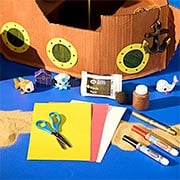
crayola supplies

household supplies

Why

Turn double-sided Crayola Color Surge™ Paper into very cool boxes! Fill your creations with treasures, present gifts in them, add pictures for a box frame, or place tiny boxes in dioramas or other projects.

Steps

  1. 1. How large will your box be? To make a pattern, cut plain paper to the size and 4-sided shape you want for the bottom of your box.
  2. 2. Trace the pattern in the center of Crayola Color Surge™ Paper using a Color Surge Marker. On each side of the shape, draw the box sides. Use the pattern or a ruler to help you make straight edges. Make all four sides the same height.
  3. 3. Add two rectangular tabs to each of two opposite sides. These tabs will wrap around to connect the sides. Cut around the outside lines of the entire shape.
  4. 4. Design both sides of the box with Crayola Color Surge Markers. Choose a theme or make each section different—you choose!
  5. 5. Fold up the four box sides. Fold tabs, glue them, and wrap tabs around the neighboring sides to form the box. Hold with fingers or paperclips until glue sets.
  6. 6. Experiment with different sizes and shapes of boxes. Construct lids using the same steps, just make them slightly larger to fit.

When & Where

"My son made little boxes for his coin collection and designed boxes with lids for his baseball cards. He turned more of them upside-down and made them into cars. "
- Carla R., mother of 8-year-old.

"The children made colorful treasure chests to hold their memory verses. They used symbols from our faith to decorate their boxes. "
- Brad & Tanya B., religious school volunteers.

Interesting Info

In February 1998 the Crayola 64-crayon box celebrated its 40th birthday with the reintroduction of its original packaging, complete with built-in sharpener and original package graphics. To help celebrate the milestone, an actual 1958 Crayola 64-crayon box, and an assortment of advertising spanning the century, became part of the permanent collection of the Smithsonian Institution's National Museum of American History.

Safety Guidelines

Adult Assistance is required for this arts & crafts project.

Scissors—ATTENTION: The cutting edges of scissors are sharp and care should be taken whenever cutting or handling. Blunt-tip scissors should be used only by children 4 years and older. Pointed-tip scissors should be used only by children 6 years and older.

© 2000 - 2006 Binney & Smith, Inc.