Swamp Stompers & Rainforest Rangers
crayola supplies
- Paint Brushes
- Crayons
- Washable Kid's Paint
- Model Magic®
- No-Run School Glue
- Blunt-Tip Scissors
- Construction Paper
household supplies
- recycled newspaper
- recycled boxes
- paper towels
- recycled file folders (optional)
- container(s) of water
- LEGO® dinosaurs
Why
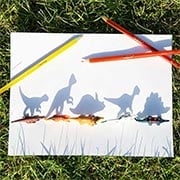
Brachiosaurus and Mosasaurus probably stomped around in swamps and rainforests. Create a realistic home for your amazing prehistoric creatures.
Steps
- 1. Brachiosaurus and Mosasaurus lived in rainforests and swamps. To create lush vegetation for your interlocking plastic dinosaurs, make texture rubbings using Crayola® Crayons. Remove the wrappers from crayons. Place a large sheet of heavy white construction paper or a recycled file folder on a rough surface. Rub the side of the crayon on the paper.
- 2. To assemble a marshy triarama backdrop, cut your crayon rubbing into a large square with Crayola Scissors. Fold it in half by joining any two corners. Open and fold again, joining the other two corners. Open. Cut along any fold to the center of the square. Overlap the two flaps to form a stand-up triarama and seal them with Crayola School Glue. Dry.
- 3. Cover your work area with newspaper. Paint the bottom of a recycled box with Crayola Washable Kid's Paint and Paint Brushes. Create both water and dry land areas for your dinosaurs. Dry.
- 4. Glue the triarama on the land. With Crayola Model Magic, create palm trees, ferns, boulders, ponds, and a dinosaur nest containing eggs. Place an interlocking plastic dinosaur and its baby on the land.
- 5. With Model Magic, create waves in the water. Place your interlocking plastic dinosaur in the water.
When & Where
"Making this dinosaur environment gave us hours of family togetherness and fun!"
- Sontoria G., mother of children ages 4, 7, and 10.
"The boys in our troop learned about the past AND worked in teams to research and create authentic Swamp Stomper habitats."
- Jack L., scout leader.
Interesting Info
Brachiosaurus was one of the tallest and largest dinosaurs. It was about 85 feet (26 m) long, weighed 33 to 88 tons (30 to 80 tonnes), and stood 40 to 50 feet (12 to 16 m) tall. A healthy adult Brachiosaurus probably had no predators. The largest-known meat-eaters from that time were less than half the size of Brachiosaurus, and most likely had much easier prey to hunt. Mosasaurus were giant, snake-like marine reptiles. They were not dinosaurs, but were related to snakes and monitor lizards.
Safety Guidelines
Crayola Modeling Materials including Crayola Model Magic®, and Model Magic Fusion™, Crayola Air-Dry Clay, and Crayola Dough—
- Keep away from open flames. Do not use to make candleholders, hot plates, trivets, or other similar objects that will be used or placed near fire and other heat sources.
- Do not put in an oven, microwave, or kiln.
- Do not make into vessels/containers that will hold unpackaged food.
- The use of modeling material to make items that look like food is discouraged for children younger than age 5 to avoid their confusion with real food.
- Unless sealed with a water-resistant glaze, do not make projects exposed to or immersed in water, such as boats or outdoor bird feeders. They would disintegrate when exposed to moisture.
- Crayola Dough—contains gluten (wheat flour) as an ingredient.
- Crayola Air-Dry Clay, Crayola Model Magic and Model Magic Fusion are gluten-free. However, they are produced on the same machinery as Crayola Dough which does contain gluten. Although the machines are cleaned prior to the start of each production run, there is a slight possibility that trace amounts of gluten from Crayola Dough may be present in the other modeling compound products. For information regarding specific ingredients or allergic concerns, please call our Consumer Affairs department at 1-800-272-9652 weekdays between 9 AM and 4 PM Eastern Standard Time.
Crayola Washable Paints—Not for use as body/face paint.
Scissors—ATTENTION: The cutting edges of scissors are sharp and care should be taken whenever cutting or handling. Blunt-tip scissors should be used only by children 4 years and older. Pointed-tip scissors should be used only by children 6 years and older.
© 2000 - 2006 Binney & Smith, Inc.