
Book on a Stick
crayola supplies
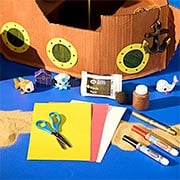
- Crayola® Oil Pastels
- Twistables®
- Blunt-Tip Scissors
- Construction Paper
household supplies
- hole punch
- paper clips
- dowel stick
- rubber bands
Why
Ever bind a handmade book? It's a snap with a rubber band and a stick! Great for a journal, travel notes, sketching, a diary, or a gift.
Steps
- 1. Binding your own book-for a diary, journal, or sketchbook-is easier than you might think. First, with Crayola® Scissors, cut at least three pages of paper in half, and then in half again, to form the pages for your book. Stack pages.
- 2. Cut heavier paper, such as construction or watercolor paper, slightly larger than the pages to make your book covers. Draw the front and back covers with Crayola Twistables Crayons or Crayola Oil Pastels. For ideas of what to draw, think about the book's purpose or relate the drawing to the stick you will use to bind the book. How about insect? Maybe a walking stick or ladybugs could crawl up the side you will bind with a stick.
- 3. Place your stack of pages between the book covers. Paper clip them together along long sides. With a paper punch, make two holes along one side (not too close to the edge).
- 4. Find a stick, such as a dowel, chopstick, or a stick that fell from a tree. The stick should be about the same length as your book is tall. Slip a long rubber band around the stick. Pass the loose end of the rubber band through one binding hole front to back, leaving the stick on the front of book. Pull the loose end of the rubber band through second hole from back to front. Slip it over the free end of the stick. Remove paper clips.
- 5. You're ready to fill your Book on a Stick! Or give it as a gift.
When & Where
"Campers made these books at the beginning of the week. They used them to record picture and word snapshots of nature."
- Velma G., camp leader.
"Our students were able to bind their own books with prideful facility."
- Marcus H., special needs volunteer assistant.
Interesting Info
Ladybugs are actually beetles. The "lady" in their name has Christian roots from "Our Lady," one name for the Virgin Mary. Ladybugs hibernate in large groups among grass roots.
Safety Guidelines
Scissors—ATTENTION: The cutting edges of scissors are sharp and care should be taken whenever cutting or handling. Blunt-tip scissors should be used only by children 4 years and older. Pointed-tip scissors should be used only by children 6 years and older.
Wood—By its nature, wood is rough and may contain splinters or sharp points
© 2000 - 2006 Binney & Smith, Inc.