
Track a Tsunami

crayola supplies

household supplies

Why?

Tsunamis, or gigantic waves, are one of the most destructive natural disasters. Discover how they’re formed, deep under the ocean surface.

Steps

  1. 1. Offshore earthquakes, volcanic eruptions, landslides, and other Earth-moving events start tsunamis. Tsunamis can race along the ocean floor at speeds of up to 600 miles per hour (960 kph) while remaining undetectable on the surface. When they reach the shore, the underwater waves turn their speed into height and can rise 70 feet (21 m) above the water's surface when they crash into the coastline. Learn more about tsunamis, how people can protect themselves, and then illustrate what you’ve learned. Here’s one way to make a poster.
  2. 2. Divide posterboard into five equal sections with horizontal lines using Crayola® Erasable Colored Pencils. Draw a long vertical line to separate your picture section from a smaller description section. Add borders to your poster.
  3. 3. With Crayola Markers, illustrate the five steps of how a tsunami is formed. Step 1 – An earthquake begins in the ocean floor. Step 2 – The ocean floor cracks from the tremors and part of the floor rises. Step 3 – Tons of water rise high above normal sea level. Step 4 – A massive swell of water spreads out in all directions. Step 5 – The tsunami hits the shore in huge waves that destroy buildings and flood everything in their paths.
  4. 4. Write short explanations about what is happening next to each picture.
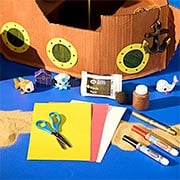
  5. 5. On more paper, draw a large wave and title for your display. Cut it out with Crayola Scissors. Attach it to your poster with Crayola School Glue. Air-dry before hanging.

adaptations

• Research what scientists are doing to create a better warning system for tsunamis, such as the Pacific Tsunami Warning Center. Find out whether there are plans to build other warning centers around the world.

• Research one new idea being tried by scientists to protect people from tsunamis, such as computerized buoys. Write a short paragraph and illustrate it.

• On a world map, plot where tsunamis have originated and struck. Why are some regions more likely to experience tsunamis?

• Assessment: Describe the five steps of forming a tsunami without referring to the poster.

benefits

• Students understand tsunamis, where they will likely occur, and that underwater earthquakes cause them.

• Students learn about what can be done to protect people from a tsunami, such as using computerized buoys, wave simulation machines, satellites, shake tables, and 3-D models to predict when and where the next one will strike.

• Students create a poster depicting the five steps in forming tsunamis.

grades

Grades 4 to 6
Grades 7 to 12

subjects

Language Arts
Science
Social Studies

time

30 to 60 minutes
Multiple Sessions

curriculum standards links

US: Research U.S. Standards
UK: Research UK Standards
Canada: Research Canada Standards

safety guidelines

Scissors—ATTENTION: The cutting edges of scissors are sharp and care should be taken whenever cutting or handling. Blunt-tip scissors should be used only by children 4 years and older. Pointed-tip scissors should be used only by children 6 years and older.

© 2000 - 2007 Crayola, LLC