Geometry in a Box

crayola supplies

household supplies

Why?

Build, sort, and classify geometric solids, then store them in a box designed with information about the figures you've made.

Steps

  1. 1. Identify and review familiar 3-dimensional geometric shapes and their mathematical names. Create an attribute grid listing the name of each figure, the number of sides, edges, vertices, and any other identifying characteristics.
  2. 2. Use Crayola® Model Magic® to build a small, accurate set of each of these space figures. Dry for 24 to 36 hours, turning pieces occasionally to expose all sides to air.
  3. 3. Write your initials on each dry shape with Crayola Fine Line Markers.
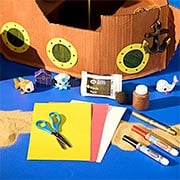
  4. 4. Find a recycled box with a lid to hold your geometric figures. Trace all sides of the box on construction paper. Cut out each piece with Crayola Scissors.
  5. 5. Draw and label all of your solid geometric figures on the papers with Crayola Metallic Colored Pencils. Attach these papers to cover all sides of the box using Crayola Washable Glue Sticks. Cover the top of the box with a paper with your name on it.

adaptations

Work in groups to sort space figures. Mix all of your solids, then classify them according to a variety of categories, including number of sides, shapes that roll, and similar sizes. Record your classifications in a diagram drawn with metallic colored pencils. Measure and record the circumference, length of sides, weight, and other attributes of each figure. Use both inches and metric measurements. Calculate the volume of each solid.

Younger students compare two space figures from their collections. Fold a piece of white paper in half. On the left side, use metallic colored pencils to list and illustrate things that are the same about the two figures. On the right side, list and illustrate things that are different. Fold the paper so it is closed and draw the two shapes on the front.

Shape one piece of wet Model Magic into several different shapes, observing how the same quantity of modeling dough looks when it is used to represent various types of solids.

benefits

Students identify, describe, build, draw, compare, and classify physical models of solid geometry figures.

Students design a box in which to store their geometric space models.

grades

Grades 1 to 3
Grades 4 to 6
Grades 7 to 12

subjects

Math
Visual Arts

time

Multiple Sessions

curriculum standards links

US: Research U.S. Standards
UK: Research UK Standards
Canada: Research Canada Standards

safety guidelines

Crayola Modeling Materials including Crayola Model Magic®, and Model Magic Fusion™, Crayola Air-Dry Clay, and Crayola Dough—

Scissors—ATTENTION: The cutting edges of scissors are sharp and care should be taken whenever cutting or handling. Blunt-tip scissors should be used only by children 4 years and older. Pointed-tip scissors should be used only by children 6 years and older.

© 2000 - 2007 Crayola, LLC