
Trade Route Timeline

crayola supplies

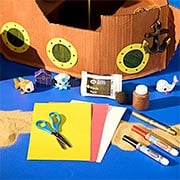
household supplies

Why?

Travel ancient trade routes! What products were exchanged? Where were the major ports? How did traders cross land? Show these routes on a map.

Steps

  1. 1. The Silk Road is one of the most famous trade routes. It was 700 miles long and spanned from China to the Roman Empires. The Chinese traded their silk for metals, precious stones, medicines, furs, and perfumes.
  2. 2. The Incense Route was another ancient trade route where fragrances such as frankincense and myrrh and spices, gold, ivory, and precious stones were brought from southern Arabia, Ethiopia, and Somalia to the Roman market. The Tin and Amber Routes were also ancient trade routes.
  3. 3. Research and locate these and other ancient trade routes. What products were traded? What methods of transportation were available? When were these routes used?
  4. 4. Use Crayola® Washable Markers to draw a map covering several trade route areas on white posterboard. Use a Peters Projection map as a reference to make sure your areas are accurately sized.
  5. 5. With different colors of yarn, diagram each trade route you researched. Include a key to identify the yarn color used for each trade route, dates the routes were used, and the map's scale.
  6. 6. Shape Crayola Model Magic into replicas of some of the trade goods. Cover your art area with newspaper. Paint the items in authentic colors with Crayola Tempera and Paint Brushes. Dry.
  7. 7. Draw other trade goods with Crayola Crayons and Colored Pencils on fabric scraps or paper. Cut them out with Crayola Scissors.
  8. 8. Use Crayola School Glue to attach your trade goods to your Trade Route Timeline. Dry.

adaptations

With a friend, pretend you are two travelers on one of the trade routes. Act out different situations you could have encountered.

Set up a system of trade in your classroom. Discuss which objects you will trade. Make a trading post to implement your system.

Compare ancient trade routes to commerce today. What products are exchanged? How are they moved?

Vasco da Gama found the first sea route from Europe to India around the southern tip of Africa in 1497. How did this change trade?

benefits

Students research details about ancient trade routes such as the silk, amber, tin, and incense routes.

Students apply their research to make a map showing the trade routes.

Students add details to maps, such as keys and samples of products traded.

grades

Grades 4 to 6
Grades 7 to 12

subjects

Math
Social Studies
Visual Arts

time

30 to 60 minutes
Multiple Sessions

curriculum standards links

US: Research U.S. Standards
UK: Research UK Standards
Canada: Research Canada Standards

safety guidelines

Crayola Modeling Materials including Crayola Model Magic®, and Model Magic Fusion™, Crayola Air-Dry Clay, and Crayola Dough—

Crayola Washable Paints—Not for use as body/face paint.

Scissors—ATTENTION: The cutting edges of scissors are sharp and care should be taken whenever cutting or handling. Blunt-tip scissors should be used only by children 4 years and older. Pointed-tip scissors should be used only by children 6 years and older.

String-Like Materials—Includes string, raffia, lacing, yarn, ribbon, and other similar material. Children 3 years and younger should not be given any string-like material that is longer than 12 inches. Close adult supervision is essential whenever children use string-like material. When crafts are to be worn around the necks of children 8 years and younger, attach the ends of the “string-like material” with clear adhesive tape, which allows easy release of the bond if the craft becomes entangled or caught on equipment. For children older than 8 years, the ends of the “string-like material” may be tied and knotted.

© 2000 - 2007 Crayola, LLC