
Parisian Picnic

Parisian Picnic lesson plan

Impressionist painter Paul Cézanne inspires original mosaic artwork as you explore Paris, France.

  • 1.

    Study Cézanne's still-life paintings. Notice that the subject matter often contains fruit and draped fabric. Look at the shapes and colors, and how the artist uses soft color marks. These bits of color create an Impression of the object being painted, which is where the art movement Impressionism got its name.

  • 2.

    Now look at a landscape done by Cézanne, or one of his contemporaries, Monet. Notice the colors they used in their work. Look carefully at some outdoor scenery. What colors do you see? How do the colors change as the sun moves in the sky? Find several photographs of Parisian landmarks, such as the Eiffel Tower. What kinds of food would you take on a picnic in Paris?

  • 3.

    On a sheet of white construction paper, sketch a picnic in Paris with Crayola® Colored Pencils. Include a small image of a Parisian landmark in the background, and a larger picnic still-life in the foreground. Look at Cézanne's still-life paintings for ideas.

  • 4.

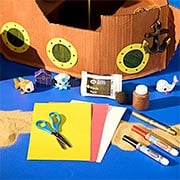
    Tear a variety of colors of construction paper (any color except black) into small pieces to color your Parisian Picnic. Begin with the background, and move forward. Layer your pieces for a richer effect. Use lighter colors to show areas of light, and darker colors to show shadows. With a Crayola Washable Glue Stick, attach the paper to your drawing.

  • 5.

    When your drawing is filled with torn paper, use dark Crayola Construction Paper Crayons to add lines and details to your Parisian Picnic. Be sure to press hard, so your lines are bold.

  • 6.

    With Crayola Scissors, cut small construction paper labels. Write the French words for foods and other items illustrated in your Parisian Picnic.

Standards

  • LA: Integrate information from several texts on the same topic in order to write or speak about the subject knowledgeably.
  • LA: Write informative/explanatory texts to examine a topic and convey ideas, concepts, and information through the selection, organization, and analysis of relevant content.
  • LA: Engage effectively in a range of collaborative discussions with diverse partners on grade level topics and texts, building on others' ideas and expressing their own clearly.
  • LA: Report on a topic or text, tell a story, or recount an experience with appropriate facts and relevant, descriptive details, speaking clearly at an understandable pace.
  • SS: Describe ways in which language, stories, folktales, music, and artistic creations serve as expressions of culture and influence behavior of people living in a particular culture.
  • SS: Use appropriate resources, data sources, and geographic tools to generate, manipulate, and interpret information.
  • SS: Explore factors that contribute to one's personal identity such as interests, capabilities, and perceptions.
  • SS: Identify and describe ways family, groups, and community influence the individual's daily life and personal choices.
  • VA: Intentionally take advantage of the qualities and characteristics of art media, techniques, and processes to enhance communication of experiences and ideas.
  • VA: Select and use the qualities of structures and functions of art to improve communication of ideas.
  • VA: Compare the characteristics of works in two or more art forms that share similar subject matter, historical periods, or cultural context.
  • VA: Identify specific works of art as belonging to particular cultures, times, and places.

Adaptations

  • Possible classroom resources include: Katie Meets The Impressionists by James Mayhew; California Impressionists by Susan Landauer; The Impressionists by Jean-Philippe Chabot
  • Invite a local artist to speak with the class about the Impressionist era. Who are the best-known artists of the period? What defines this period from other art eras? After the meeting, students post learning to a class blog.
  • Students investigate the life and career of a self-selected artist from the Impressionist era. What was his early life like? What professional training did the artist participate in? What preferences did the artist have? Include any additional information about the artist that the student feels is important in understanding the individual and his work. Prepare an electronic presentation for classmates.
  • Organize a field trip to a local museum to view artwork from the Impressionist era. Prior to the trip, brainstorm with students what they would like to focus on while away on the trip. Afterwards, students post learning to a class blog.
  • Compare and contrast various artists' approaches to still life paintings or mosaic techniques.