Ancient Dress For Success

Why

Explore cultures through clothing, using a variety of Crayola® Erasable Colored Pencils and construction paper to make 3-D models of hats, garments, and accessories worn by various peoples of the world.


Steps

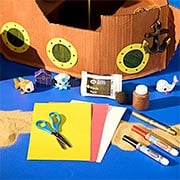
1. On white paper, design 3-dimensional patterns for ancient people's clothing and accessories using Crayola Colored Pencils. Cut out the patterns with Crayola Scissors.


2. Trace the patterns on colored construction paper with the colored pencils. Cut these out and fold pieces as necessary.


3. Add color, texture, and detail to the clothing with different Crayola Colored Pencils. For shiny effects, such as for armor, use Crayola Metallic Colored Pencils.


4. Glue clothing pieces together as needed with Crayola School Glue.


Safety Guidelines

Adult supervision is required for any arts & crafts project. Observe children closely and intervene as necessary to prevent potential safety problems and ensure appropriate use of arts and crafts materials. Some craft items, particularly beads and buttons, are potential choking hazards for young children. Avoid use of such small parts with children younger than 3 years. Craft items such as scissors, push pins and chenille sticks may have sharp points or edges. Avoid use of materials with sharp points by children younger than 4 years. Read all manufacturers' safety warnings before using arts and craft supplies.

Costumes & Masks— CAUTION: When children wear hand-crafted costumes and masks, make sure the crafts do not obstruct the child’s vision, hearing, or impede movement. Do not use feathers, fabric, or raffia on wearable costumes and masks because these items do not pass costume flammability tests. Wearable masks are those held in place on the face with elastic, yarn, or other materials. Keep away from open flames.

Scissors—ATTENTION: The cutting edges of scissors are sharp and care should be taken whenever cutting or handling. Blunt-tip scissors should be used only by children 4 years and older. Pointed-tip scissors should be used only by children 6 years and older.

Adaptations

  • For early readers, find books with pictures of traditional and contemporary clothing. Encourage young children to draw their impressions with Crayola Write Start Colored Pencils.
  • Offer computer design programs for young and special education students who are still developing finger and hand control.
  • Older students could create imaginary labels (fabric content, size, laundering instructions), safety warnings (for their garments). Encourage them to use the written language that people in the culture used, or design pictorial symbols to convey the message if writing had not yet been invented.
  • Encourage students to choose an ethnic group from their own heritage. Broaden children's understandings by considering foods, music, homes, and other elements of the culture. Invite families and others in the community to share their knowledge and artifacts.

Related Lesson Plans

Lesson Plans

Share on Facebook

Supplies

crayola supplies
  • Colored Pencils
  • Metallic Colored Pencils
  • No-Run School Glue
  • Blunt-Tip Scissors
  • Construction Paper
household supplies
  • white paper

Overview

grades

  • Pre-K and Kindergarten
  • Grades 1 to 3
  • Grades 4 to 6
  • Grades 7 to 12
  • Special Needs

subjects

  • Language Arts
  • Science
  • Social Studies
  • Visual Arts

time

  • 30 to 60 minutes
  • Multiple Sessions

benefits

  • Students research the environment (climate, vegetation, animals) and customs (language, technology) of people living in a culture during a specific time period.

  • Using these findings, students design and create authentic clothing and accessories depicting those worn by people in that culture and time period.

  • Students summarize their findings, and describe why they chose their garment designs and materials, in a written or oral report.

Cirriculum

Research Canada Standards
Research UK Standards
Research U.S. Standards