Birth of Islands

Why

Learn how islands are formed then build models of different kinds of islands to show what you've learned.


Steps

1. Divide into teams of 3 or 4 students to design imaginary or real islands. Record a list of choices about the characteristics of the island using Crayola® Colored Pencils.


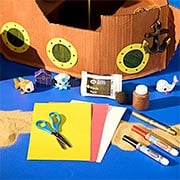
2. With Crayola Model Magic, create 3-dimensional island models. Use a cardboard base if necessary. Incorporate recycled collage materials such as twigs, paper towel tubes, craft sticks, toothpicks, or cotton balls to form island features. Attach with Crayola School Glue.


3. When the Model Magic is dry, cover the work area with recycled newspaper. Paint the island's land forms and bodies of water with Crayola Watercolor Paint or Tempera Paint and Brushes.


4. Choose names for the island as well as its parts, such as peninsulas, inlets, coves, basins, valleys, mountain ranges, and lakes. Make labels with Crayola Colored Pencils or Washable Markers.


Safety Guidelines

Adult supervision is required for any arts & crafts project.

Crayola Modeling Materials including Crayola Model Magic®, Model Magic Fusion™, Crayola Air-Dry Clay, and Crayola Dough With Small Parts— WARNING: CHOKING HAZARD—

  • Keep away from open flames. Do not use to make candleholders, hot plates, trivets, or other similar objects that will be used or placed near fire and other heat sources.
  • Do not put in an oven, microwave, or kiln.
  • Do not make into vessels/containers that will hold unpackaged food.
  • If the arts & crafts project involves making small objects, follow the small parts/choking hazards standards: WARNING: CHOKING HAZARD—Small parts. Not for children under 3 years."
  • The use of modeling material to make items that look like food is discouraged for children younger than age 5 to avoid their confusion with real food.
  • Unless sealed with a water-resistant glaze, do not make projects exposed to or immersed in water, such as boats or outdoor bird feeders. They would disintegrate when exposed to moisture.
  • Crayola Dough—contains gluten (wheat flour) as an ingredient. Crayola Air-Dry Clay, Crayola Model Magic, and Model Magic Fusion are gluten-free. However, they are produced on the same machinery as Crayola Dough which does contain gluten. Although the machines are cleaned prior to the start of each production run, there is a slight possibility that trace amounts of gluten from Crayola Dough may be present in the other modeling compound products. For information regarding specific ingredients or allergic concerns, please call our Consumer Affairs department at 1-800-272-9652 weekdays between 9 AM and 4 PM Eastern Standard Time.

Small Parts— WARNING: CHOKING HAZARD—Small parts. Not for children under 3 years.

Crayola Washable Paints—Not for use as body/face paint.

Wood—By its nature, wood is rough and may contain splinters or sharp points

Adaptations

  • Advanced students can simulate economies among their islands. Use the islands' natural resources to pursue trade, agriculture, and industry. Consider how these "developments" would affect the islands and their people.
  • Observe a local island over time. Draw natural as well as people-made features in journals. Record seasonal changes, such as water lines and vegetation.
  • Construct islands with sand and experiment with the effects of wind, water, plants, and people on them. Tie the sand and Model Magic constructions to understandings about beaches, ports, fishing, floods, and lighthouses.
  • Encourage development of mapping skills. Draw maps of islands showing geography, topography, climate, vegetation, population, language, wealth, natural resources, or other features.

Related Lesson Plans

Lesson Plans


Supplies

crayola supplies
  • Paint Brushes
  • Colored Pencils
  • Markers
  • Washable Watercolors
  • Washable Kid's Paint
  • Watercolor Brushes with Plastic Handle
  • Model Magic®
  • No-Run School Glue
  • Construction Paper
household supplies
  • recycled newspaper
  • cotton balls (optional)
  • paper towels
  • collage materials
  • cardboard
  • craft sticks (optional)
  • toothpicks - wooden (optional)

Overview

grades

  • Grades 1 to 3
  • Grades 4 to 6
  • Grades 7 to 12

subjects

  • Language Arts
  • Science
  • Social Studies
  • Visual Arts

time

  • Multiple Sessions

benefits

  • Students research how islands are formed (once connected then chipped off continents, low-lying land bridge became submerged, spurts of molten lava from undersea volcanoes, or gradual build-up of organic material) and locate real examples of each type.

  • Students work in groups to build real or imaginary islands, accurately presenting how they accurately represent how the island was formed, where it is located on earth, its features, climactic conditions, how plant and animal life reached the island, and what life is found there.

  • Students summarize ideas, use new terminology, and practice public speaking skills as they present island models to classmates.

Cirriculum

Research Canada Standards
Research UK Standards
Research U.S. Standards