
Carnevale Capers
Visit Venice during Carnevale—or any time. Design striking decorative masks in a classic Italian celebratory style!
1. Step back in time to the Venice of the 1200s. The laws in this Italian city allowed people to wear masks on many different occasions. Why did laws govern mask wearing? Well, masks allow various types of people to mingle. sks permit people to gain entry to places that would ordinarily be denied to them. And masks enable people to avoid others. Carnevale was one time when masks could be worn.
2. What else can you discover about Carnevale and Italian mask-making? You will learn that mask makers (Maschereri) had such a busy trade that they had their own crafts guild. Find out how the early masks looked and how they were made and decorated. Many mask styles may be seen in the art of the times.
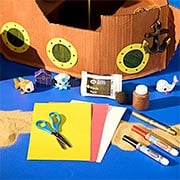
3. Pay tribute to this venerable craft by constructing a decorative mask in the Venetian style. Form the basic shape with aluminum foil to create an armature upon which to mold your mask. Shape eyes, ears, and a nose.
4. Cover the foil armature with colorful Crayola® Model Magic®. Mix colors of the modeling compound or blend them with white to create your own colors. For a marbled effect, stop mixing colors at a halfway point. Use a drinking straw to poke an opening in the back for hanging.
5. Choose decorative elements for your mask. Twist chenille stems around Crayola Colored Pencils to form curls. Add colored shapes of Model Magic to the curls. Poke in decorative craft materials. Secure decorations with Crayola School Glue as needed. Air-dry your mask at least 24 hours before hanging to display.
Adult supervision is required for any arts & crafts project.
Costumes & Masks—
CAUTION: When children wear hand-crafted costumes and masks, make sure the crafts do not obstruct the child’s vision, hearing, or impede movement. Do not use feathers, fabric, or raffia on wearable costumes and masks because these items do not pass costume flammability tests. Wearable masks are those held in place on the face with elastic, yarn, or other materials. Keep away from open flames.
Crayola Modeling Materials including Crayola Model Magic®, Model Magic Fusion™, Crayola Air-Dry Clay, and Crayola Dough With Small Parts—
WARNING: CHOKING HAZARD—
- Keep away from open flames. Do not use to make candleholders, hot plates, trivets, or other similar objects that will be used or placed near fire and other heat sources.
- Do not put in an oven, microwave, or kiln.
- Do not make into vessels/containers that will hold unpackaged food.
- If the arts & crafts project involves making small objects, follow the small parts/choking hazards standards:
WARNING: CHOKING HAZARD—Small parts. Not for children under 3 years." - The use of modeling material to make items that look like food is discouraged for children younger than age 5 to avoid their confusion with real food.
- Unless sealed with a water-resistant glaze, do not make projects exposed to or immersed in water, such as boats or outdoor bird feeders. They would disintegrate when exposed to moisture.
- Crayola Dough—contains gluten (wheat flour) as an ingredient. Crayola Air-Dry Clay, Crayola Model Magic, and Model Magic Fusion are gluten-free. However, they are produced on the same machinery as Crayola Dough which does contain gluten. Although the machines are cleaned prior to the start of each production run, there is a slight possibility that trace amounts of gluten from Crayola Dough may be present in the other modeling compound products. For information regarding specific ingredients or allergic concerns, please call our Consumer Affairs department at 1-800-272-9652 weekdays between 9 AM and 4 PM Eastern Standard Time.
Sharp Point—
CAUTION: Contains a functional sharp point and should not be used by children under 4 years. Close adult supervision is required and adult assistance may be needed.
Small Parts—
WARNING: CHOKING HAZARD—Small parts. Not for children under 3 years.
- Find out more about carnivals around the world including those in Trinidad, Rio de Janeiro, Brazil, and New Orleans. In what ways are they similar and different?
- Much of the classic costumes and masks of Carnevale come out of the Comedia Dell’Arte tradition. Learn more about this tradition and its effect upon Carnivale style.
- Discuss the theme of one year’s Carnevale: "To mask oneself in order to unmask." Find out the theme of the upcoming Carnevale and its meaning.
- Study the role that Venice plays in Shakespeare’s theatre.