Community Celebrations 3-D Timeline
Which special events are celebrated in your community? Create a 3-D timeline of community events—for any season!
1. A community becomes more than just a group of people living in the same place when they join together for special events such as parades, festivals, and picnics. Gather information about events in your community such as outdoor band concerts, recycling events, and health fairs. Use Crayola Erasable Colored Pencils to record all of the information you find. You can easily erase if you need to correct spellings or change the dates.
2. Write all the information on 12 large sheets of chart paper, one for each month of the year. Break into groups of two or three children, each group focusing on one month. Find out more about the community events that are scheduled in your assigned month. Send letters to the event coordinators to get details on what happens at the event, where it is located, times, and who sponsors it.
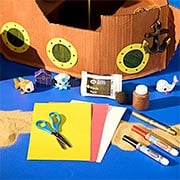
3. Work with your group, using your imaginations and Crayola Model Magic® compound to create 3-dimensional representations of the events in your month. Be as creative as you like, forming miniature scenes or simple representations of the event, such as a watermelon for a community picnic or a float for a community parade.
4. Here’s one idea: To create a bandshell to represent a summer concert, roll Model Magic compound flat with a marker barrel. Cut it in half. Curve one piece up and around the other piece, so one piece forms the floor and the other piece the curved walls and roof of the bandshell.
5. Stack Model Magic strips to make risers. Create tiny musicians and their instruments, seated on the risers. Air-dry your sculpture for 24 hours.
6. On a paper roll, create a 12-month timeline. Write each month along the line with Crayola Markers. Place the 3-D creations along the time line. Write details of each event on the timeline. Display your creation in a public building such as a library.
Adult supervision is required for any arts & crafts project. Observe children closely and intervene as necessary to prevent potential safety problems and ensure appropriate use of arts and crafts materials. Some craft items, particularly beads and buttons, are potential choking hazards for young children. Avoid use of such small parts with children younger than 3 years. Craft items such as scissors, push pins and chenille sticks may have sharp points or edges. Avoid use of materials with sharp points by children younger than 4 years. Read all manufacturers' safety warnings before using arts and craft supplies.
Crayola Modeling Materials including Crayola Model Magic®, and Model Magic Fusion™, Crayola Air-Dry Clay, and Crayola Dough—
- Keep away from open flames. Do not use to make candleholders, hot plates, trivets, or other similar objects that will be used or placed near fire and other heat sources.
- Do not put in an oven, microwave, or kiln.
- Do not make into vessels/containers that will hold unpackaged food.
- The use of modeling material to make items that look like food is discouraged for children younger than age 5 to avoid their confusion with real food.
- Unless sealed with a water-resistant glaze, do not make projects exposed to or immersed in water, such as boats or outdoor bird feeders. They would disintegrate when exposed to moisture.
- Crayola Dough—contains gluten (wheat flour) as an ingredient.
- Crayola Air-Dry Clay, Crayola Model Magic and Model Magic Fusion are gluten-free. However, they are produced on the same machinery as Crayola Dough which does contain gluten. Although the machines are cleaned prior to the start of each production run, there is a slight possibility that trace amounts of gluten from Crayola Dough may be present in the other modeling compound products. For information regarding specific ingredients or allergic concerns, please call our Consumer Affairs department at 1-800-272-9652 weekdays between 9 AM and 4 PM Eastern Standard Time.
Scissors—ATTENTION: The cutting edges of scissors are sharp and care should be taken whenever cutting or handling. Blunt-tip scissors should be used only by children 4 years and older. Pointed-tip scissors should be used only by children 6 years and older.
- In spring, focus on community events scheduled for the upcoming summer. Find out how children and their families might get involved in the events. Invite parents to form community involvement teams to lead groups of students in participating in community events throughout their summer vacation.
- The school is the center of the community in many municipalities. Focus on school events that occur throughout the year. Identify months that have few or no events scheduled and think of an event your class could sponsor. Brainstorm ways to include the community in these events, particularly citizens who do not have children in the school system.
- Assessment: Before creating the community event timeline, children work together to construct a rubric outlining what an excellent, good, OK, and not-so-good display would look like. Invite children to use the rubric to evaluate their display when it is completed.