Domino Phonics

Why

Long vowels. Short vowels. Digraphs. Figuring out phonics can be fun with these dominoes and a classmate or two.


Steps

1. English is a complex language to learn. Knowing how letters and words are pronounced is essential. Here’s an easy way to make a set of dominoes with your choice of different sounds or letter blends. We started with long vowel sounds. With a partner or two, choose your domino challenge!


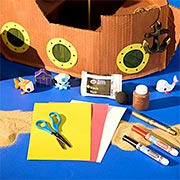
2. Cut the bones. With Crayola® Scissors, cut out 20 or more rectangles from recycled foam produce trays. Make sure these "bones" are big enough on which to write a word and sound.


3. Fill the bones. With Crayola Gel Markers, divide each rectangle in half. Write a long vowel sound such as ee, oa, ai, y, i-e, ea, oo, ay, or igh on one side of each rectangle. Write words that have these sounds on the other side. Mix up the sounds and words.


4. Play! Shuffle bones face down. Pick five. First player lays a tile down. Other players add matching words or corresponding vowel sounds. If a player cannot move, pick tiles until you are able to add one.


Safety Guidelines

Adult supervision is required for any arts & crafts project. Observe children closely and intervene as necessary to prevent potential safety problems and ensure appropriate use of arts and crafts materials. Some craft items, particularly beads and buttons, are potential choking hazards for young children. Avoid use of such small parts with children younger than 3 years. Craft items such as scissors, push pins and chenille sticks may have sharp points or edges. Avoid use of materials with sharp points by children younger than 4 years. Read all manufacturers' safety warnings before using arts and craft supplies.

Scissors—ATTENTION: The cutting edges of scissors are sharp and care should be taken whenever cutting or handling. Blunt-tip scissors should be used only by children 4 years and older. Pointed-tip scissors should be used only by children 6 years and older.

Adaptations

  • Tailor the content of dominoes to address identified learning needs and for learning other languages. They’re great for spelling, too!
  • Decorate colorful envelopes or shoe boxes in which to organize and store the games. Suggest that families make similar games to play at home with their children.
  • Dominoes were probably invented in China more than 300 years ago. They were first used to tell the future, then for playing. Find out more about this game that’s played around the world. Explore the different indigenous materials used to make sets. What other games are played across the globe?
  • Search Crayola.com for more early literacy games and manipulatives.

Related Lesson Plans

Lesson Plans

Share on Facebook

Supplies

crayola supplies
  • Gel Markers
  • Pointed Tip Scissors
household supplies
  • recycled foam produce trays

Overview

grades

  • Grades 4 to 6
  • Special Needs
  • Grades 1 to 3

subjects

  • Language Arts
  • Visual Arts

time

  • Less than 1/2 hour

benefits

  • Students work in pairs or trios to identify long vowels sounds and corresponding words (or other phonics challenges).

  • Students fabricate a simple phonics game based on traditional dominoes.

  • Students reinforce their phonics learning by playing a group game.

Cirriculum

Research Canada Standards
Research UK Standards
Research U.S. Standards