Don't Spill the Oil
Investigate the impact of oil spills and efforts made to prevent and clean up such environmental accidents.
1. Research the pros, cons, efficiencies, and availability of various sources of energy. Consider environmental and economic perspectives. Recognize the dependence of various countries on oil for transportation and manufacturing. Find out how oil is transported.
2. Focus on the effects of oil spills on water, coastlines, and plant and animal life in these habitats. Research a specific oil spill to examine the cause, amount of oil spilled, cleanup efforts, and impact on waterways, landforms, plants, animals, people, and economies.
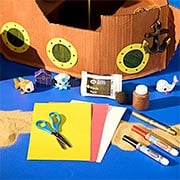
3. Create a 3-dimensional relief scene that demonstrates the effect of this oil spill. Use a base of firm cardboard or thin wood. Build up either white or colored Crayola® Model Magic® into landforms such as mountains, glaciers, islands, or tundra as well as the water. Kneading black, blue, and white Model Magic together creates an authentic-looking oil spill effect.
4. Depict the source of the spill (such as pipeline rupture, undersea oil well leak, oil tanker collision, loading error from barge) with Model Magic. Create objects found in the water and indicate the extent of the spill. Use pieces of cardboard rolls, twigs, or other craft items, cutting them with Crayola Scissors, as needed.
5. Form pieces of Model Magic to demonstrate the effects of the spill on animals such as birds, beaches, and sea life. Create models of cleanup methods used (such as spill skimmers or absorbent pads, chemical sprays from airplanes, hot water washes off coastal areas, bacteria treatments, booms to contain the spill, rescue equipment). Use Crayola School Glue to attach all pieces to the base.
6. Cover the work area with recycled newspaper. Paint details on dry Model Magic with Crayola Watercolors or Washable Paint and Brushes, or Markers. Paint on a glaze of glue mixed with water to create shiny surfaces.
Adult supervision is required for any arts & crafts project.
Crayola Modeling Materials including Crayola Model Magic®, Model Magic Fusion™, Crayola Air-Dry Clay, and Crayola Dough With Small Parts—
WARNING: CHOKING HAZARD—
- Keep away from open flames. Do not use to make candleholders, hot plates, trivets, or other similar objects that will be used or placed near fire and other heat sources.
- Do not put in an oven, microwave, or kiln.
- Do not make into vessels/containers that will hold unpackaged food.
- If the arts & crafts project involves making small objects, follow the small parts/choking hazards standards:
WARNING: CHOKING HAZARD—Small parts. Not for children under 3 years." - The use of modeling material to make items that look like food is discouraged for children younger than age 5 to avoid their confusion with real food.
- Unless sealed with a water-resistant glaze, do not make projects exposed to or immersed in water, such as boats or outdoor bird feeders. They would disintegrate when exposed to moisture.
- Crayola Dough—contains gluten (wheat flour) as an ingredient. Crayola Air-Dry Clay, Crayola Model Magic, and Model Magic Fusion are gluten-free. However, they are produced on the same machinery as Crayola Dough which does contain gluten. Although the machines are cleaned prior to the start of each production run, there is a slight possibility that trace amounts of gluten from Crayola Dough may be present in the other modeling compound products. For information regarding specific ingredients or allergic concerns, please call our Consumer Affairs department at 1-800-272-9652 weekdays between 9 AM and 4 PM Eastern Standard Time.
Small Parts—
WARNING: CHOKING HAZARD—Small parts. Not for children under 3 years.
Crayola Washable Paints—Not for use as body/face paint.
- Write journal entries from several perspectives such as those of the tanker captain, oil company executive, local resident, cleanup worker, or animal affected by the spill.
- Students with motor disabilities might work as partners with others who can help form the Model Magic® as they request.
- Compile a chart of ways students can save each of the types of energy they listed. Design, write, and conduct a public information campaign with the school or community about ways to conserve natural resources.