
Germany's Noble Neuschwanstein
Explore German history from the Middle Ages to modern times. Study German castles, such as Neuschwanstein Castle, then design and build one of your own.
1. Find Germany on European and world maps. Research the country's history and its culture. Find pictures and descriptions of some of the hundreds of ancient palaces and castles located in Germany. What materials were used in their construction? Why are they still standing after so many years?
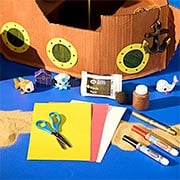
2. With a variety of different boxes, cardboard rolls, and other recycled materials, put together a castle. Cut construction paper or paper cups with Crayola® Scissors to make turrets. Attach pieces with Crayola School Glue and masking tape.
3. Cover your work area with recycled newspaper. Paint the castle using Crayola Washable Paint and Paint Brushes. Dry.
4. Glue on doors and windows cut from construction paper. Use craft sticks, foam produce trays, and/or paper plates to add accents to your castle. Color in details with Crayola Washable Markers.
Adult supervision is required for any arts & crafts project.
Sharp Point—
CAUTION: Contains a functional sharp point and should not be used by children under 4 years. Close adult supervision is required and adult assistance may be needed.
Small Parts—
WARNING: CHOKING HAZARD—Small parts. Not for children under 3 years.
Crayola Washable Paints—Not for use as body/face paint.
Recycled Cardboard Tubes—Use paper towel tubes, gift-wrap tubes, or long cardboard tubes that can be cut to any length. Health professionals caution against using recycled toilet paper tubes for arts & crafts projects because of the potential fecal contamination.
Recycled Foam Produce Trays—Wash in hot, soapy water. No meat or poultry trays should be used.
Scissors—ATTENTION: The cutting edges of scissors are sharp and care should be taken whenever cutting or handling. Blunt-tip scissors should be used only by children 4 years and older. Pointed-tip scissors should be used only by children 6 years and older.
Wood—By its nature, wood is rough and may contain splinters or sharp points
- Younger students or those with learning disabilities focus on one aspect of German history, such as the construction of castles. Gather information about daily life in castles, such as clothing, food, daily routines, and transportation. Design costumes and props to reenact typical castle events.
- Research one German castle, such as the famous Neuschwanstein located in the Bavarian Alps, to find out the many interesting facts about it.
- Construct other German architecture such as a magnificent cathedral or fortress.