Giving Thanks Placemats

Why

What are you thankful for? Find out how gratitude played a role in historic Thanksgiving celebrations. Make your own placemat with historic images and your own message of thanks.


Steps

1. How did the U.S. or Canadian Thanksgiving become a holiday? Who might have been at the first harvest feast in North America? What did they probably eat? Why is the holiday celebrated today? Think about what you are thankful-perhaps a loving family, warm home, or your artistic skills!


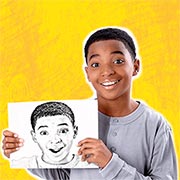
2. To make a Thanksgiving placemat, draw a person's head on construction paper. Shade in the face with Crayola Multicultural Markers. With Crayola Fine Tip Markers, add other facial features of either a European Pilgrim immigrant or Native American.


3. Research information about what the Wampanoag, Massachuset, and other Native Americans who lived in what is now Massachusetts in 1620 might have worn on their heads. Using construction paper, draw an historic hair style, Pilgrim man's felt hat, a woman's coif, or an authentic Native American ornament. Cut it out and glue it on the face. Glue the person onto a construction paper backing.


4. Trace your hands on another sheet of construction paper with Crayola Colored Pencils. Color them with Multicultural Markers. Use markers to write "I Am Thankful For" on one hand. Write what you are thankful for on the other. Glue the hands to either side of the person. Air-dry the glue.


5. If you wish, ask an adult to cover your placemat with clear plastic adhesive so it can be wiped clean with a damp cloth.


Safety Guidelines

Adult supervision is required for any arts & crafts project.

Small Parts— WARNING: CHOKING HAZARD—Small parts. Not for children under 3 years.

Adult Assistance is required for this arts & crafts project.

Scissors—ATTENTION: The cutting edges of scissors are sharp and care should be taken whenever cutting or handling. Blunt-tip scissors should be used only by children 4 years and older. Pointed-tip scissors should be used only by children 6 years and older.

Adaptations

  • Using Crayola® Markers, create a scene depicting what you think the first traditional Thanksgiving in North America might have looked like, including Native Americans and Pilgrims.
  • After researching the legends of the first Thanksgiving, construct a collage filled with drawings of foods the pilgrims and Native Americans would have eaten, such as squash, corn, beans, and pumpkins. All are native to North America.
  • Find out about harvest celebrations in other cultures, including those of Native Americans. In addition to foods, what other traditions are observed?

Related Lesson Plans

Lesson Plans


Supplies

crayola supplies
  • Fine Line Markers
  • Erasable Colored Pencils
  • Multicultural Markers
  • Glue Sticks
  • Blunt-Tip Scissors
  • Construction Paper
household supplies
  • clear plastic adhesive (such as Con-Tact® paper)

Overview

grades

  • Pre-K and Kindergarten
  • Grades 1 to 3
  • Grades 4 to 6

subjects

  • Language Arts
  • Social Studies
  • Visual Arts

time

  • 30 to 60 minutes

benefits

  • Children study the origins of the traditional Thanksgiving and why this holiday is still celebrated by many people in North America today.

  • Students analyze and determine what they are grateful for in their daily lives.

  • Students create a placemat which states what they are thankful for and depicts historic images.

Cirriculum

Research Canada Standards
Research UK Standards
Research U.S. Standards