
Layers With Lines
How are landforms such as mountains and valleys drawn on maps? Learn about landforms and how to draw a topographical map, using lines to show elevation.
1. The ongoing challenge for every realistic artist is how to make an object drawn on a flat piece of paper look three-dimensional. This is the same challenge faced by cartographers, the people who draw maps. Most people want to know the variations of ground heights before they set out on a hike, dig a tunnel, excavate for a road, or build a house.
2. Topographical maps show the features of the earth's surface in a number of different ways. On early maps, hills and other features were simply drawn in. Now some maps vary in colors to indicate land features such as mountains or streams. Contour lines on maps join points at the same height in concentric circles. They show not only height but grade (how steep an elevation is) as well. The closer together the circles are, the steeper the elevation.
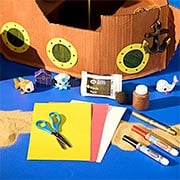
3. Contour lines can add dimension to a collage. Experiment with the optics of lines to see how this works. Tear or cut interesting shapes from colorful construction paper. Using a Crayola® Glue Stick, attach collage pieces to a large white paper. Leave open spaces between the shapes.
4. Notice that the white spaces create new shapes. With Crayola Fine Line Markers, outline the insides of the open spaces. With different colors, draw parallel lines inside the outlines, getting smaller and smaller in the same way as contour lines.
5. Look at the lines in your collage. See how the lines make the spaces move either in and down or up and out.
Adult supervision is required for any arts & crafts project. Observe children closely and intervene as necessary to prevent potential safety problems and ensure appropriate use of arts and crafts materials. Some craft items, particularly beads and buttons, are potential choking hazards for young children. Avoid use of such small parts with children younger than 3 years. Craft items such as scissors, push pins and chenille sticks may have sharp points or edges. Avoid use of materials with sharp points by children younger than 4 years. Read all manufacturers' safety warnings before using arts and craft supplies.
Scissors—ATTENTION: The cutting edges of scissors are sharp and care should be taken whenever cutting or handling. Blunt-tip scissors should be used only by children 4 years and older. Pointed-tip scissors should be used only by children 6 years and older.
- Choose one color for each contour line. See how that changes the drawing. For example, make the first contour line black, the second yellow, the third green.
- Experiment with real contour lines. Build a hill with sand or Crayola Model Magic. Bore holes in the hill with a Crayola Colored Pencil all around the hill. Measure the heights. Wrap different colors of yarn around the hill to join the holes of each row of matching heights. Look down at the hill. Now draw the lines on flat paper.>
- Play a matching game between land features such as cliff, valley, mesa, steep mountain, gentle hill, and contour drawings of each one.