Moves Count
Design an original board game to use math skills. Sculpt playing pieces with Crayola® Model Magic. Clear directions and rules are a challenge to create, too!
1. What are your favorite board games? Which ones use math? Here's your chance to make a game of your own. Design it to challenge your skills!
2. First, figure out a theme. What math skills and facts do you want to feature? How will players move forward? Plan some frustrating pitfalls. Figure out how players will pay for their mistakes, too. Come up with some great game strategies!
3. This is one way to design a game. Invent your own imaginative board, game pieces, and rules.
4. Using Crayola Colored Pencils, sketch a spiral of connected blocks on foam board. Begin in the center. End the spiral near the outer edge of the board. With Crayola Washable Markers, write START on the last block.
5. Draw a symbol, number, or small picture in each block to match your theme and strategies. Design and color the rest of the board.
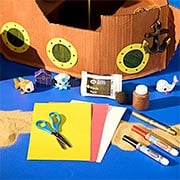
6. Create unique game pieces with Crayola Model Magic. Sculpt landmarks such as bridges, wind tunnels, or trees. To create your own colors, rub color from a Crayola Washable Marker into the modeling material and knead. Do this several times to get the shade you want.
7. Cut out paper cards with Crayola Scissors. Write directions on each card, such as Move 1 step forward, Move 4 steps back, Go to the red bridge, or Lose a Turn. Make dice with Crayola Model Magic. Can you make dice with more than six sides? Fewer?
8. To play, players choose a card (or roll the dice) in turn and move accordingly. The first player to reach the center of the board wins.
Adult supervision is required for any arts & crafts project.
Crayola Modeling Materials including Crayola Model Magic®, Model Magic Fusion™, Crayola Air-Dry Clay, and Crayola Dough With Small Parts—
WARNING: CHOKING HAZARD—
- Keep away from open flames. Do not use to make candleholders, hot plates, trivets, or other similar objects that will be used or placed near fire and other heat sources.
- Do not put in an oven, microwave, or kiln.
- Do not make into vessels/containers that will hold unpackaged food.
- If the arts & crafts project involves making small objects, follow the small parts/choking hazards standards:
WARNING: CHOKING HAZARD—Small parts. Not for children under 3 years." - The use of modeling material to make items that look like food is discouraged for children younger than age 5 to avoid their confusion with real food.
- Unless sealed with a water-resistant glaze, do not make projects exposed to or immersed in water, such as boats or outdoor bird feeders. They would disintegrate when exposed to moisture.
- Crayola Dough—contains gluten (wheat flour) as an ingredient. Crayola Air-Dry Clay, Crayola Model Magic, and Model Magic Fusion are gluten-free. However, they are produced on the same machinery as Crayola Dough which does contain gluten. Although the machines are cleaned prior to the start of each production run, there is a slight possibility that trace amounts of gluten from Crayola Dough may be present in the other modeling compound products. For information regarding specific ingredients or allergic concerns, please call our Consumer Affairs department at 1-800-272-9652 weekdays between 9 AM and 4 PM Eastern Standard Time.
Small Parts—
WARNING: CHOKING HAZARD—Small parts. Not for children under 3 years.
Scissors—ATTENTION: The cutting edges of scissors are sharp and care should be taken whenever cutting or handling. Blunt-tip scissors should be used only by children 4 years and older. Pointed-tip scissors should be used only by children 6 years and older.
Sponges and Foam—Sponges, foam, and other expandable materials should not be used with children 3 years old and younger.
- Create games for other curriculum areas such as geography, spelling, or science. Build both facts and skills into the strategies. Some students with special needs may find it helpful to adapt rules from a familiar game.
- Work in small groups to invent games for younger children. Then play the game with them. Evaluate which strategies were most effective with younger children.
- Design a life-size, outdoor board game with Crayola Sidewalk Chalk.