Pythons in the Wild

Why

Where do pythons live? What do these notorious snakes look like? Create a fascinating 3-D science project in a recycled box.


Steps

1. Learn more about pythons by visiting Web sites. Read books such as Verdi by Janell Cannon or Snakes by Seymour Simon. Pythons and other snakes usually live in environments where they can hide from predators. In this project, you will create a natural python habitat diorama. A python might be found in water, in trees, or even curled up on a rock, depending on the type of python! Use your imagination and the information you gathered to plan your diorama. These are some ideas.


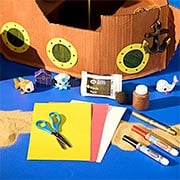
2. Cover a recycled cardboard box with construction paper that goes with the python theme. Cut or tear the paper to achieve a natural background look.


3. Cover your craft area with newspaper. Paint details into the scene and on the outside of the box. Mix colors to achieve a realistic look. Paint a cardboard tube to look like a fallen log upon which a python might rest. Air-dry the paint.


4. Sculpt a Crayola Model Magic® pond or stream in the scene. Air-dry it for 24 hours before placing it into your scene.


5. Glue the log and natural materials, such as moss, stones, and twigs, into the diorama.


6. Cut large leaves from construction paper. Decorate them with Crayola Markers. Glue leaves to the inside of the box so they hang down around the inside of your diorama. You might add leaves to the outside of your display, too.


7. Roll out beautiful Model Magic pythons. Hang them over branches, around rocks, and in the water. Create other details with Model Magic and paper to complete your python display.


8. Display your diorama with a report containing information about pythons.


Safety Guidelines

Adult supervision is required for any arts & crafts project.

Small Parts— WARNING: CHOKING HAZARD—Small parts. Not for children under 3 years.

Crayola Modeling Materials including Crayola Model Magic®, and Model Magic Fusion™, Crayola Air-Dry Clay, and Crayola Dough—

  • Keep away from open flames. Do not use to make candleholders, hot plates, trivets, or other similar objects that will be used or placed near fire and other heat sources.
  • Do not put in an oven, microwave, or kiln.
  • Do not make into vessels/containers that will hold unpackaged food.
  • The use of modeling material to make items that look like food is discouraged for children younger than age 5 to avoid their confusion with real food.
  • Unless sealed with a water-resistant glaze, do not make projects exposed to or immersed in water, such as boats or outdoor bird feeders. They would disintegrate when exposed to moisture.
  • Crayola Dough—contains gluten (wheat flour) as an ingredient.
  • Crayola Air-Dry Clay, Crayola Model Magic and Model Magic Fusion are gluten-free. However, they are produced on the same machinery as Crayola Dough which does contain gluten. Although the machines are cleaned prior to the start of each production run, there is a slight possibility that trace amounts of gluten from Crayola Dough may be present in the other modeling compound products. For information regarding specific ingredients or allergic concerns, please call our Consumer Affairs department at 1-800-272-9652 weekdays between 9 AM and 4 PM Eastern Standard Time.

Crayola Washable Paints—Not for use as body/face paint.

Scissors—ATTENTION: The cutting edges of scissors are sharp and care should be taken whenever cutting or handling. Blunt-tip scissors should be used only by children 4 years and older. Pointed-tip scissors should be used only by children 6 years and older.

Wood—By its nature, wood is rough and may contain splinters or sharp points

Adaptations

  • Play Python Trivia. Generate and ask each other questions about pythons.
  • Hold a Python Web Quest. Small groups investigate different types of pythons. Take turns teaching the class in oral presentations. Make a chart to compare and contrast different kinds of pythons.
  • Create snakes that blend with the habitat. Classmates try to find the number of pythons in each other’s dioramas!
  • Invent, create, and describe a unique species of python. Imagine the python’s appearance, habitat, and behavior.
  • Assessment: Students found detailed information about python habitats and lives. Dioramas were carefully constructed and contained representative details of a python habitat in the wild.

Related Lesson Plans

Lesson Plans


Supplies

crayola supplies
  • Markers
  • Artista II® Washable Tempera Paint
  • Arts & Crafts Brushes
  • Model Magic®
  • No-Run School Glue
  • Pointed Tip Scissors
  • Construction Paper
household supplies
  • recycled newspaper
  • recycled cardboard roll from Hallmark gift wrap
  • paper towels
  • recycled cardboard box
  • container(s) of water
  • natural materials (stones, shells, dried plant sprigs)

Overview

grades

  • Grades 4 to 6

subjects

  • Science
  • Visual Arts

time

  • 30 to 60 minutes

benefits

  • Students research information about python habitats and anatomy.

  • Students create a 3-D model to represent what they learned about how a python’s appearance and behavior relate to its natural environment.

Cirriculum

Research Canada Standards
Research UK Standards
Research U.S. Standards