Rainbow Trout
Find out about fish and the different environments fish live in then design a painted stuffed fish for a biodiversity exhibit.
1. There are many varieties of colorful fish in the world. Although these creatures can be found in many different environments, many of the most dramatic and interesting fish are found in coral reefs. These reefs, a delicate balance of living organisms, can be found in the oceans near Australia and Central America. Other types of fish live in rivers, streams, bays, lakes, and ponds. If not careful, people can have a negative impact on these amazing natural wonders.
2. Research the anatomical similarities and differences among fish species. All fish have eyes, gills, scales, fins, mouths, and tails.
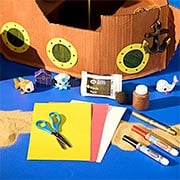
3. On a large piece of paper, use Crayola® Colored Pencils to outline a big fish with anatomical features you learned about, or be ready to add them later. Choose a specific type of fish and make your drawing as accurate as possible.
4. Use Crayola Scissors to cut out your fish. Place this large cutout on top of a second sheet of paper, trace around it, and cut out the second fish.
5. Staple the two layers of your fish together almost all the way around the edges, leaving a space unstapled at the bottom. Ask an adult to help you.
6. Use recycled newspaper to stuff the fish. Crumple newspaper into loose balls, then push the balls gently into the opening. When the fish is slightly rounded, staple the opening closed.
7. Cover a table with recycled newspaper. Use Crayola Washable Kid's Paints and Paint Brushes to design colorful patterns on one side of your fish. Dry.
8. Paint the other side of the fish. Dry.
9. Use Crayola® Washable Glitter Glue to add sparkling details. Be sure to give your fish eyes, gills, and fins! Dry.
10. Exhibit the fish as part of a display on biodiversity, either depicting local or international fish habitats.
Adult supervision is required for any arts & crafts project.
Glitter Glue—
WARNING: CHOKING HAZARD—Small parts. Not for children under 3 years. Not for use on skin.
Sharp Point—
CAUTION: Contains a functional sharp point and should not be used by children under 4 years. Close adult supervision is required and adult assistance may be needed.
Crayola Washable Paints—Not for use as body/face paint.
Scissors—ATTENTION: The cutting edges of scissors are sharp and care should be taken whenever cutting or handling. Blunt-tip scissors should be used only by children 4 years and older. Pointed-tip scissors should be used only by children 6 years and older.
- Study various types of trout or other fish that are found in your area. Interview fish and wildlife specialists, frequent fishers, scientists, fishery officials, chefs, and others who know about the habitat and uses of these fish. Explore how the fish environment is maintained and restocked. Visit an aquarium or other facility with many types of fish.
- Make several small tropical or freshwater fish. Use brightly colored thread to hang them from a long cardboard roll for a swimming fish mobile.
- Outline a tropical fish on construction paper. Cut out the fish, then draw a second outline about two fingers wide inside the edge. Cut the center from your fish outline, resulting in a fish-shaped border. Place this border on clear plastic adhesive, such as Con-Tact® paper. Use bits of brightly colored paper and small amounts of Crayola Washable Glitter Glue to fill in the interior spaces. Apply a second piece of clear plastic adhesive to the top of your fish, and gently press the two pieces together. Cut out your fish and add details with Crayola Markers. Hang your fish in a window for a translucent effect.