
Walking in Your Shoes

Why

Imagine you could put on someone else’s comfortable shoes. What would you see if you were walking in an unfamiliar place?


Steps

1. What kind of shoes would you wear if you lived in another country? In Senegal, children wear sandals; in England, some might have oxfords; and in Switzerland a pair of hiking boots might be the best fit. Choose a place to explore in your imagination. Find out what kind of shoes you would wear if you lived there. Then create a unique display to show what you might see while wearing those shoes.


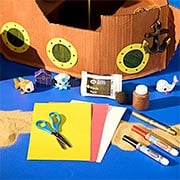
2. Sculpt your shoe. Scrunch newspaper into a shoe shape. Use masking tape to hold your paper armature in place. Roll neon Crayola Model Magic® into a flat sheet with a Crayola Marker. Drape the modeling compound over the newspaper to shape it into footwear. Roll coils in contrasting colors. Attach them to the shoe for the sole, laces, or straps. Use your fingernail or a marker cap to impress details such as stitching or tread. Air-dry the shoe overnight.


3. Make local cutouts. On construction paper, draw and color what you would see as a traveler in the country. In Switzerland, you could find the Alps, brown Swiss cattle, cheese, skis, and timepieces. Cut out your drawings with Crayola Scissors, leaving a small tab at the bottom of each one to attach it to the poster.


4. Show the country. Trace the country’s name and land mass on posterboard. Fill in its flag with Crayola Erasable Colored Pencils. Erase areas as needed. For example, Switzerland’s flag has a white cross in a field of red. 5. Ask an adult to cut slits in posterboard where you will attach your cutouts. Slide tabs through the slits and fold up. Attach the shoe and cutouts with Crayola School Glue. Air-dry the display before you explain the country to your class.


Safety Guidelines

Adult supervision is required for any arts & crafts project. Observe children closely and intervene as necessary to prevent potential safety problems and ensure appropriate use of arts and crafts materials. Some craft items, particularly beads and buttons, are potential choking hazards for young children. Avoid use of such small parts with children younger than 3 years. Craft items such as scissors, push pins and chenille sticks may have sharp points or edges. Avoid use of materials with sharp points by children younger than 4 years. Read all manufacturers' safety warnings before using arts and craft supplies.

Adult Assistance is required for this arts & crafts project.

Crayola Modeling Materials including Crayola Model Magic®, and Model Magic Fusion™, Crayola Air-Dry Clay, and Crayola Dough—

  • Keep away from open flames. Do not use to make candleholders, hot plates, trivets, or other similar objects that will be used or placed near fire and other heat sources.
  • Do not put in an oven, microwave, or kiln.
  • Do not make into vessels/containers that will hold unpackaged food.
  • The use of modeling material to make items that look like food is discouraged for children younger than age 5 to avoid their confusion with real food.
  • Unless sealed with a water-resistant glaze, do not make projects exposed to or immersed in water, such as boats or outdoor bird feeders. They would disintegrate when exposed to moisture.
  • Crayola Dough—contains gluten (wheat flour) as an ingredient.
  • Crayola Air-Dry Clay, Crayola Model Magic and Model Magic Fusion are gluten-free. However, they are produced on the same machinery as Crayola Dough which does contain gluten. Although the machines are cleaned prior to the start of each production run, there is a slight possibility that trace amounts of gluten from Crayola Dough may be present in the other modeling compound products. For information regarding specific ingredients or allergic concerns, please call our Consumer Affairs department at 1-800-272-9652 weekdays between 9 AM and 4 PM Eastern Standard Time.

Scissors—ATTENTION: The cutting edges of scissors are sharp and care should be taken whenever cutting or handling. Blunt-tip scissors should be used only by children 4 years and older. Pointed-tip scissors should be used only by children 6 years and older.

Adaptations

  • Make an audio component to go with your poster. Find samples of some of the languages you would hear. In Switzerland, there are four official languages: German, French, Italian, and Romansh. What kinds of music are popular in the country? Play samples of them as well.
  • Discuss the Cheyenne saying "Do not judge your neighbor until you walk two moons in his moccasins." Start an initiative at your school based on this theme to help short-circuit bullying and to develop tolerance and appreciation of others.
  • Assessment: Students demonstrate a deeper understanding of the chosen country that is meaningful and compassionate. Fewer incidents of criticisms and negative behavior are exhibited in the classroom.

Related Lesson Plans

Lesson Plans

Share on Facebook

Supplies

crayola supplies
  • Erasable Colored Pencils
  • Model Magic®
  • No-Run School Glue
  • Pointed Tip Scissors
  • Construction Paper
household supplies
  • recycled newspaper
  • posterboard
  • masking tape
  • sharp knife (for adult use only!)

Overview

grades

  • Grades 1 to 3
  • Grades 4 to 6

subjects

  • Social Studies
  • Visual Arts

time

  • 30 to 60 minutes
  • Multiple Sessions

benefits

  • Students research information about clothing and major attributes of another country or area.

  • Students see things in their area of study from a resident’s perspective.

  • Students express their understanding about another culture’s attributes in a 3-D presentation.

Cirriculum

Research Canada Standards
Research UK Standards
Research U.S. Standards