My Shadow Pictures

My Shadow Pictures lesson plan

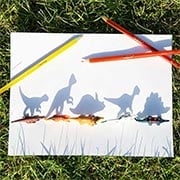
Capture shadows for a shadow dance!

  • 1.

    Experiment with shadows created by people or items blocking light sources (sun, bright lamp). On a sunny day, find a safe place outdoors, such as a sidewalk, where children can draw their shadows with Crayola® Sidewalk Chalk, children work in partners to draw each other's shadows. Try different poses. Record shadow sizes and shapes at various times of the day.

  • 2.

    Create shadow pictures with stencils. On heavy paper, such as oak tag or recycled file folders, use Crayola Crayons or Colored Pencils to recreate shadow shapes similar to the life-size drawings. With Crayola Scissors, cut out the center of the drawing to make a stencil.

  • 3.

    Cover the work area with recycled newspaper. Dilute Crayola School Glue with an equal amount of water. Brush this mixture on a sheet of dark construction paper with Crayola Paint Brushes.

  • 4.

    While the glue is still wet, gently place the shadow stencil on the construction paper. Quickly, rub Crayola Colored Drawing Chalk against sandpaper or a piece of screen so chalk flecks fall onto the open stencil. Gently lift the stencil to see the shadow picture.

  • 5.

    Cut out stenciled shadows and arrange them on a large piece of mural paper. The frolicking shadows create a shadow dance.

Standards

  • LA: Participate in collaborative conversations with diverse partners about grade level topics and texts with peers and adults in small and larger groups.
  • LA: Report on a topic or text, tell a story, or recount an experience with appropriate facts and relevant, descriptive details, speaking clearly at an understandable pace.
  • MATH: Use ratio and rate reasoning to solve real-world and mathematical problems, e.g., by reasoning about tables of equivalent ratios, tape diagrams, double number line diagrams, or equations.
  • SCI: Construct models and representations of body systems to demonstrate how multiple interacting subsystems and structures work together to accomplish specific functions.
  • SCI: Provide explanations of how sense receptors respond to stimuli by sending messages to the brain to be processed for immediate behavior or stored as information.
  • VA: Employ organizational structures and analyze what makes them effective or not effective in the communication of ideas.

Adaptations

  • Students collaborate in small groups to observe and document shadows at different times of the day, or once a week at the same time throughout the year. Students trace the shadows on large sheets of paper. Compare shadow sizes to the height of the human model.
  • Using recycled boxes, students create Crayola model Magic characters and props. Use a flashlight to create shadows in the shadow box. Students document shadows and discuss how the positioning of the light source alters the shadow.
  • Students analyze how vision works. What physical systems are used to see shadows, or other stimuli? Students organize research into an electronic format for presentation to classmates.
  • As a class, students play Shadow Tag. Encourage students to engage their brains as well as their bodies so as to avoid standing in another player's shadow.