
Sheep to Sweaters

Sheep to Sweaters lesson plan

Find out how sheep fleece is turned into wool yarn by hand, then show what you know in a 3-D shadowbox.

  • 1.

    Did you know that sheep were the first animals to be domesticated by humans? Think about the things that sheep provide for people--wool, meat, and milk. What do people provide to sheep?

  • 2.

    There are many steps between touching a woolly sheep and wearing a cozy sweater. Research how people converted raw wool into sweaters before they used today's machines. Visit an historic site that does sheep shearing to see the process first hand.

  • 3.

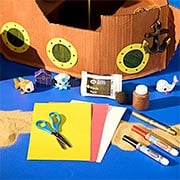
    Cover your workspace with newspaper. Choose a recycled box or cardboard platform on which to create a 3D diorama of this historic procedure for making clothing. With Crayola® Washable Paint, Paint Brushes, and Crayola Washable Markers, create a landscape of the environment in which sheep live and graze such as mountains, hills, or farms.

  • 4.

    Use large cotton balls to make sheep. If you wish to have sheep with black or brown fleece, color cotton balls with markers. Fashion sheep legs and heads using twigs, or use Crayola Scissors to cut chenille sticks. Use Crayola School Glue to hold sheep together.

  • 5.

    A sheep's fleece protects it from cold weather, but this protection is not needed during warmer months. The fleece is cut off (sheared) before lambing (giving birth to lambs). Sheep grow an average of 8 pounds (3.6 kilograms) of wool each year. Shearing is like having your hair cut. The skin stays on the sheep and only the wooly fleece is cut off.

  • 6.

    Include in your display the tools used in the sheep shearing and wool preparation process. Draw or construct them out of collage items and recycled materials. Sheep shears clip the fleece off. Two wool carders, which look like dog-grooming brushes, clean

  • 7.

    Include in your display the tools used in the sheep shearing and wool preparation process. Draw or construct them out of collage items and recycled materials. Sheep shears clip the fleece off. Two wool carders, which look like dog-grooming brushes, clean and detangle the fibers of the fleece. A spinning wheel or drop spindle twists the fleece into yarn. All of these tools are powered by human muscle.

Standards

  • LA: Read and comprehend informational texts, including history/social studies, science, and technical texts, at the high end of the grade level text complexity band independently and proficiently.
  • LA: Engage effectively in a range of collaborative discussions (one-on-one, in groups, and teacher-led) with diverse partners on grade level topics and texts, building on others’ ideas and expressing their own clearly.
  • LA: Write routinely over extended time frames (time for research, reflection, and revision) and shorter time frames (a single sitting or a day or two) for a range of discipline-specific tasks, purposes, and audiences.
  • MATH: Convert among different-sized standard measurement units within a given measurement system (e.g., convert 5 cm to 0.05 m), and use these conversions in solving multi-step, real world problems.
  • SCI: Construct explanations of how structures in animals serve functions of growth, survival, reproduction, and behavior.
  • SS: Describe ways in which language, stories, folktales, music, and artistic creations serve as expressions of culture and influence behavior of people living in a particular culture.
  • SS: Use appropriate resources, data sources, and geographic tools to generate, manipulate, and interpret information.
  • SS: Identify and use various sources for reconstructing the past, such as documents, letters, diaries, maps, textbooks, photos, and others.
  • VA: Use different media, techniques, and processes to communicate ideas, experiences, and stories.
  • VA: Use visual structures of art to communicate ideas.

Adaptations

  • Possible classroom resources include: Farmer Brown Shears His Sheep: A Yarn About Wool by Teri Sloat; Weaving the Rainbow by George Ella Lyon; The Goat in the Rug by Charles L. Blood & Martin Link; Charlie Needs a Cloak by Tomie dePaola
  • Organize a field trip to a sheep farm for students. Prior to the trip, students compose questions for the farmer. After the trip, student post learning to a class blog.
  • Invite a knitter or weaver to visit the class and demonstrate carding, spinning, and/or weaving. Allow time in the visit for students to explore the process with the expert. After the meeting, students post learning to a class blog.
  • There are tiny hooks in wood fibers that lock together, much like Velcro™ which is one reason why wool is a valuable fiber. Purchase enough raw wood to provide each student in the class with a small amount. Allow time during this lesson for students to manipulate the wool fibers and test the strength of the wool fibers.