
Skip to Main Content

Spring Silhouette Garden

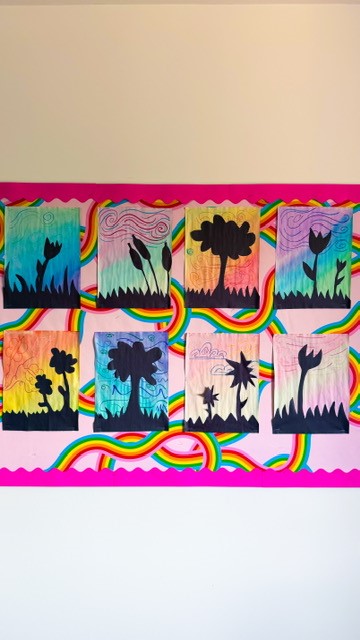
Learning Goal: We are learning to create a bright spring artwork using colour, contrast, and silhouettes while exploring how art materials can be creative and low mess.

Lesson Plan Created by: Stephanie Lazarevski

Lesson Plan

Supplies Needed

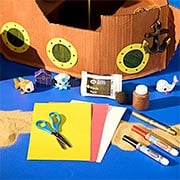
Gather all the supplies needed to bring your craft ideas to life! From paints and markers to glue and scissors, our crafts section has everything to spark creativity and make every project truly special.

Steps

  • Step 1: Colour Freely

    Begin by filling your entire paper with bright, vibrant colours that represent spring, such as greens, blues, yellows, and pinks. Try to cover all of the white space so your background looks full and lively. As you work, experiment with blending and layering different colours to create interesting transitions. You do not need to worry about staying perfectly inside the lines. This step is about creativity and expression rather than perfection.

  • Step 2: Add Texture

    Once your background is complete, use crayons, pencil crayons, and/or markers to draw over top of your colours to add texture and detail. You can create spring-inspired designs such as flowers, swirls, and sun shapes, allowing your artwork to become more visually interesting. As you draw, experiment with how you apply pressure. Try pressing lightly in some areas for softer marks and more firmly in others to create bold, defined lines. This variation will help add depth and texture to your overall composition.

  • Step 3: Cut Silhouettes

    Using black construction paper, carefully cut out simple shapes to represent elements of a spring garden. You might choose to create flowers, blades of grass, or butterflies. Keep your designs bold and easy to recognize, avoiding small or overly detailed cuts. These shapes will act like silhouettes, which means they will appear as solid black forms that stand out clearly against your colourful background.


  • Step 4: Build Your Garden

    Once your silhouettes are ready, begin arranging them on top of your colourful background to create your spring garden scene. Think carefully about where to place each shape before gluing and try overlapping some of your pieces to create a sense of depth and layering. This will help your artwork look more dynamic and visually interesting, as if some elements are closer while others are further away.

  • Step 5: Quick Reflection

    Reflect on your finished piece and identify the part that stands out the most to you. Be prepared to share your thoughts about your choices and what you are most proud of in your artwork.

Standards

Grade 5/6 Curriculum Connections

A1: Creating and Presenting

  • A1.2: Demonstrate an understanding of composition, using elements of design to create narrative or expressive artwork. (Use of foreground: silhouettes and background, colour, layering, and space).
  • A1.3: Use elements of design in art works to communicate ideas, messages, and understandings (Colour: bright spring tones, contrast: black silhouettes, texture: crayon details).

A2: Reflecting, Responding, and Analyzing

  • A2.2: Explain how their own art works communicate their feelings and ideas (Reflection questions: how does your work show spring?)

    A3: Exploring Forms and Cultural Contexts

  • A3.2: Demonstrate an understanding of a variety of art forms, styles, and techniques
    (Use of mixed media (markers, crayons, collage).


Adaptations