
Falling Leaves Poetry Spinners

crayola supplies

household supplies

Why?

Observing leaves inspires scientists and poets alike. Combine the two by making falling leaf marks and writing poetry.

Steps

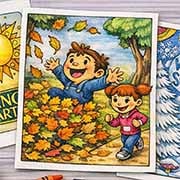
  1. 1. Go out on a mildly windy fall day to watch leaves and seedpods fall from trees. Time how long it takes for different types to fall. Notice the directions, motions, and "dances" they make while falling. Mimic the movement with Crayola Color Pencil sketches. Gather safe, fallen leaves and seed pods. Wash hands after collecting them.
  2. 2. Identify the different leaves and seed pods. With Crayola Markers, create a chart. Glue the leaves and pods to the chart.
  3. 3. Read classic poems and/or listen to classic songs about fall and falling leaves. For example, listen to "Autumn Leaves." "Les Feuilles Mortes," in French or English, is a fun, inspirational recording. Read Robert Frost’s poem "October." Write original poems about fall.
  4. 4. Draw the largest possible oval on construction paper. Write a poem within the oval using Crayola No Drip Paint Brush Pens. Use the brush much like a calligraphy pen to get swirling letters. Use different colors to highlight words or lines.
  5. 5. On the other side of the paper, draw the movements of different falling leaves to create beautiful patterns. Listen to music while doing this to inspire your movements. Use a different color for each pattern.
  6. 6. Begin cutting a spiral along the edge of the oval. Cut inward, leaving about the width of two fingers between spirals. Cut closer and closer until you reach the center.
  7. 7. Punch a hole in the center. Tie ribbon to hang spirals from the ceiling or windows. Create a room of falling leaves and poetry. Read poetry aloud to each other.

adaptations

Collect leaves and hang in a display. Identify them. Plant seeds gathered from the ground in small containers.

Present student poetry in a performance. Hang spirals on the stage. Create falling leaf movement and dance.

Choose one tree and record seasonal changes by drawing its leaves throughout the year. Make a large tree with a paper roll and change the leaves as the seasons change. Let them fall on the ground in autumn.

Assessment: Did students time falling leaves? Did they understand the difference in times? How accurately did they record data about leaves and seed pods? Were students engaged in listening to poetry? Did they invent poems that were unique and thoughtful? Did they follow directions to make their spirals?

benefits

Students record and chart data about natural phenomena.

Students experience active mark making related to movement.

Students discover new poetry about fall and falling leaves.

Students write original poetry.

Students present their poems in a unique spiral format as well as orally.

grades

Grades 4 to 6
Grades 7 to 12

subjects

Language Arts
Math
Science
Visual Arts

time

30 to 60 minutes

curriculum standards links

US: Research U.S. Standards
UK: Research UK Standards
Canada: Research Canada Standards

safety guidelines

Scissors—ATTENTION: The cutting edges of scissors are sharp and care should be taken whenever cutting or handling. Blunt-tip scissors should be used only by children 4 years and older. Pointed-tip scissors should be used only by children 6 years and older.

String-Like Materials—Includes string, raffia, lacing, yarn, ribbon, and other similar material. Children 3 years and younger should not be given any string-like material that is longer than 12 inches. Close adult supervision is essential whenever children use string-like material. When crafts are to be worn around the necks of children 8 years and younger, attach the ends of the “string-like material” with clear adhesive tape, which allows easy release of the bond if the craft becomes entangled or caught on equipment. For children older than 8 years, the ends of the “string-like material” may be tied and knotted.

© 2000 - 2007 Crayola, LLC