Hides That Reveal

crayola supplies

household supplies

Why?

Study Native American use of animal hides for homes and clothing.

Steps

  1. 1. Learn how many Native American peoples cured and used animal hides. The Plains Indians, for example, made teepees and clothing. Teepee designs often portrayed history, war scenes, and symbols of supernatural creatures related to the male teepees dweller's fast-induced visions and dreams. Hanging hides were often used for record keeping. If possible, find out how indigenous peoples in your area used animal hides, and which animals were available.
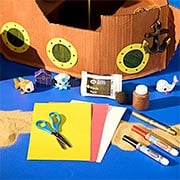
  2. 2. Roll white Crayola® Model Magic® with a dowel, rolling pin, or fingers to 1/8 inch (3 mm) thick. Let it stiffen slightly.
  3. 3. Decide whether to make a teepee or hanging hide. Use Crayola Scissors or a plastic knife to cut the compound into a pelt shape (hanging hide) or half circle (teepee).
    Pelt: Punch two holes in the upper legs with a punch or stick. Use yarn to hang the pelt from a stick.
    Teepee: Make a tripod with three sticks. Wrap the sticks together at the top with yarn. For stability, press the sticks into a base of recycled rigid foam used for packing. Then wrap the teepee hide around the sticks. Tie it in place with yarn. Let the Model Magic dry or cure.
  4. 4. Use Crayola Washable Fine Tip Markers or MiniStampers to create personal designs, with each student's history and dreams.
  5. 5. Share the stories depicted on these hides with classmates or families during an open house.

adaptations

Less experienced students or those with motor disabilities may be more successful with the hanging pelts.

More experienced students might construct an elaborate teepee. After lashing the 3 sticks together in a tripod, use another 3 sticks to form a rough circle at the base. Lash these to the tripod. Put Crayola School Glue on the outside of the sticks and then wrap the hide around the sticks.

Write journal entries describing the meaning of each of the symbols on the hide. Explore the shapes and meanings of similar symbols used by various Native American tribes. How have people's experiences and dreams changed over the years?

benefits

Students learn about Plains Indian life, including the people's use of animal hides for clothing and shelter.

Students create symbols, in the fashion of those used by Native Americans, to represent and communicate their experiences and dreams.

grades

Grades 1 to 3
Grades 4 to 6
Special Needs

subjects

Language Arts
Social Studies
Visual Arts

time

Multiple Sessions

curriculum standards links

US: Research U.S. Standards
UK: Research UK Standards
Canada: Research Canada Standards

safety guidelines

Crayola Modeling Materials including Crayola Model Magic®, and Model Magic Fusion™, Crayola Air-Dry Clay, and Crayola Dough—

Modeling Tools—Use the least dangerous point or edge sufficient to do the job. For example, craft sticks, plastic knives and forks, and cookie cutters can cut or carve modeling materials.

Scissors—ATTENTION: The cutting edges of scissors are sharp and care should be taken whenever cutting or handling. Blunt-tip scissors should be used only by children 4 years and older. Pointed-tip scissors should be used only by children 6 years and older.

Sponges and Foam—Sponges, foam, and other expandable materials should not be used with children 3 years old and younger.

String-Like Materials—Includes string, raffia, lacing, yarn, ribbon, and other similar material. Children 3 years and younger should not be given any string-like material that is longer than 12 inches. Close adult supervision is essential whenever children use string-like material. When crafts are to be worn around the necks of children 8 years and younger, attach the ends of the “string-like material” with clear adhesive tape, which allows easy release of the bond if the craft becomes entangled or caught on equipment. For children older than 8 years, the ends of the “string-like material” may be tied and knotted.

Wood—By its nature, wood is rough and may contain splinters or sharp points

© 2000 - 2007 Crayola, LLC