
Moves Count

crayola supplies

household supplies

Why?

Design an original board game to use math skills. Sculpt playing pieces with Crayola® Model Magic. Clear directions and rules are a challenge to create, too!

Steps

  1. 1. What are your favorite board games? Which ones use math? Here's your chance to make a game of your own. Design it to challenge your skills!
  2. 2. First, figure out a theme. What math skills and facts do you want to feature? How will players move forward? Plan some frustrating pitfalls. Figure out how players will pay for their mistakes, too. Come up with some great game strategies!
  3. 3. This is one way to design a game. Invent your own imaginative board, game pieces, and rules.
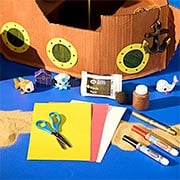
  4. 4. Using Crayola Colored Pencils, sketch a spiral of connected blocks on foam board. Begin in the center. End the spiral near the outer edge of the board. With Crayola Washable Markers, write START on the last block.
  5. 5. Draw a symbol, number, or small picture in each block to match your theme and strategies. Design and color the rest of the board.
  6. 6. Create unique game pieces with Crayola Model Magic. Sculpt landmarks such as bridges, wind tunnels, or trees. To create your own colors, rub color from a Crayola Washable Marker into the modeling material and knead. Do this several times to get the shade you want.
  7. 7. Cut out paper cards with Crayola Scissors. Write directions on each card, such as Move 1 step forward, Move 4 steps back, Go to the red bridge, or Lose a Turn. Make dice with Crayola Model Magic. Can you make dice with more than six sides? Fewer?
  8. 8. To play, players choose a card (or roll the dice) in turn and move accordingly. The first player to reach the center of the board wins.

adaptations

Create games for other curriculum areas such as geography, spelling, or science. Build both facts and skills into the strategies. Some students with special needs may find it helpful to adapt rules from a familiar game.

Work in small groups to invent games for younger children. Then play the game with them. Evaluate which strategies were most effective with younger children.

Design a life-size, outdoor board game with Crayola Sidewalk Chalk.

benefits

By drawing step-by-step procedures, students demonstrate their ability to plan a mathematical game with directions.

Students devise rewards for ingenious play, pitfalls, and consequences for blunders.

Students create a themed board game which includes directions, the playing board, landmarks, and board pieces.

grades

Grades 1 to 3
Grades 4 to 6

subjects

Math
Visual Arts

time

Multiple Sessions

curriculum standards links

US: Research U.S. Standards
UK: Research UK Standards
Canada: Research Canada Standards

safety guidelines

Crayola Modeling Materials including Crayola Model Magic®, and Model Magic Fusion™, Crayola Air-Dry Clay, and Crayola Dough—

Scissors—ATTENTION: The cutting edges of scissors are sharp and care should be taken whenever cutting or handling. Blunt-tip scissors should be used only by children 4 years and older. Pointed-tip scissors should be used only by children 6 years and older.

Sponges and Foam—Sponges, foam, and other expandable materials should not be used with children 3 years old and younger.

© 2000 - 2007 Crayola, LLC