Colorful Covers

crayola supplies

household supplies

Why?

What's inside these Colorful Covers? A journal? E-mail addresses? Class notes? Photos? This book is great for cool-looking reports!

Steps

  1. 1. How could you use a blank book? To write a journal? List e-mail addresses? Present a report? Write poetry? Choose how you will use your Colorful Covers.
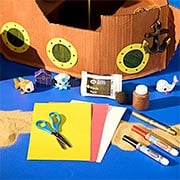
  2. 2. Use your imagination to design a bright book cover. With Crayola® Colored Pencils, draw a picture in a shape that tells about what's inside. If you plan to write a report on a state or province, make the book in that shape, for example.
  3. 3. Color your drawing with Crayola Crayons. Accent it with Crayola Washable Markers. Mix colors to make your own originals. Add words to describe your book. Cut out around your drawing with Crayola Scissors.
  4. 4. For the inside pages, cut white paper the same size and shape as your cover. Line up the cover and pages. Punch two or three holes along one edge. Thread each hole with ribbon and tie securely.
  5. 5. Record information, poems, or lists in your book with colored pencils. Organize your material so it is clear and logical.

adaptations

Students with special needs might create their Colorful Covers with a partner or adult at home. Use assistive technology as appropriate.

Create a photo album about a friend or family member. Fill the book with photos, short stories, and funny things that have happened to you both.

Create a cover to match the topic of a school report. If you are doing a report on New York City, create the Empire State Building as the cover for your report.

Design a cover that tells all about yourself. Draw your family and best friends. Find out about your family history and create a family tree inside. Keep a record of relatives, how they're related to you, and where they live now.

benefits

Students select a purpose for making blank books with Colorful Covers.

Children design book covers to illustrate their hobbies, report topics, or other content.

Students demonstrate the ability to gather pertinent information and write it in a clear and logical order.

grades

Grades 4 to 6
Special Needs
Grades 1 to 3

subjects

Language Arts
Math
Visual Arts

time

Less than 1/2 hour
30 to 60 minutes

curriculum standards links

US: Research U.S. Standards
UK: Research UK Standards
Canada: Research Canada Standards

safety guidelines

Scissors—ATTENTION: The cutting edges of scissors are sharp and care should be taken whenever cutting or handling. Blunt-tip scissors should be used only by children 4 years and older. Pointed-tip scissors should be used only by children 6 years and older.

String-Like Materials—Includes string, raffia, lacing, yarn, ribbon, and other similar material. Children 3 years and younger should not be given any string-like material that is longer than 12 inches. Close adult supervision is essential whenever children use string-like material. When crafts are to be worn around the necks of children 8 years and younger, attach the ends of the “string-like material” with clear adhesive tape, which allows easy release of the bond if the craft becomes entangled or caught on equipment. For children older than 8 years, the ends of the “string-like material” may be tied and knotted.

© 2000 - 2007 Crayola, LLC