Recycle Inventions
crayola supplies
- Paint Brushes
- Markers
- Artista II® Washable Tempera Paint
- Model Magic®
- No-Run School Glue
household supplies
- recycled newspaper
- recycled paper
- recycled boxes
- paper towels
- masking tape
- container(s) of water
- recycled foam produce trays (optional)
Why?
The creative inventions of Leonardo daVinci inspire imaginative problem-solving as you design, construct, and paint your own invention.
Steps
- 1. Study Leonardo daVinci's drawings of flying machines. When were these inventions conceptualized? How are they similar to today's flight vehicles? How do they differ?
- 2. Collect recyclables such as wood and foam produce trays. Sketch your ideas for an invention made with these recycled items. Start with an idea and fit the materials to it, or look at the items and decide what to make.
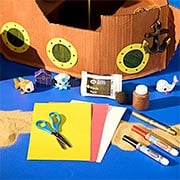
- 3. Arrange your materials in the shape of your invention. Glue parts together with Crayola® School Glue, using masking tape to hold the structure in place temporarily if necessary. Dry overnight, then remove the tape.
- 4. Use Crayola Model Magic to add details to your invention. Dry 24 hours.
- 5. Cover your work area with recycled newspaper. Paint your invention with Crayola Tempera and Brushes. Mix colors to achieve the effects you want.
- 6. On an index card, write the name, description, and instructions for using your invention with Crayola Washable Markers.
adaptations
Younger children and those with special needs might begin by constructing their invention and then sketch the finished product. Take turns sharing inventions and their uses with classmates.
Try to recreate one of daVinci's inventions with recycled materials. What knowledge (physics, math) did he need to envision his idea?
Write a story about your invention. Illustrate it with step-by-step pictures of the creative process.
benefits
Children learn about the creative inventions of Leonardo daVinci.
Students collect recycled materials for their projects.
Children use their imaginations and problem solving skills to design, construct, and paint their own inventions.
grades
Grades 1 to 3
Grades 4 to 6
Grades 7 to 12
Special Needs
subjects
Language Arts
Science
Visual Arts
time
Multiple Sessions
curriculum standards links
US:
Research U.S. Standards
UK:
Research UK Standards
Canada:
Research Canada Standards
safety guidelines
Crayola Modeling Materials including Crayola Model Magic®, and Model Magic Fusion™, Crayola Air-Dry Clay, and Crayola Dough—
- Keep away from open flames. Do not use to make candleholders, hot plates, trivets, or other similar objects that will be used or placed near fire and other heat sources.
- Do not put in an oven, microwave, or kiln.
- Do not make into vessels/containers that will hold unpackaged food.
- The use of modeling material to make items that look like food is discouraged for children younger than age 5 to avoid their confusion with real food.
- Unless sealed with a water-resistant glaze, do not make projects exposed to or immersed in water, such as boats or outdoor bird feeders. They would disintegrate when exposed to moisture.
- Crayola Dough—contains gluten (wheat flour) as an ingredient.
- Crayola Air-Dry Clay, Crayola Model Magic and Model Magic Fusion are gluten-free. However, they are produced on the same machinery as Crayola Dough which does contain gluten. Although the machines are cleaned prior to the start of each production run, there is a slight possibility that trace amounts of gluten from Crayola Dough may be present in the other modeling compound products. For information regarding specific ingredients or allergic concerns, please call our Consumer Affairs department at 1-800-272-9652 weekdays between 9 AM and 4 PM Eastern Standard Time.
Crayola Washable Paints—Not for use as body/face paint.
Recycled Foam Produce Trays—Wash in hot, soapy water. No meat or poultry trays should be used.
© 2000 - 2007 Crayola, LLC