Across the Landscape

Why

Create a unique, stunning display of the Earth’s landforms. Showcase learning with textured materials such as sandpaper, aluminum foil, and corrugated paper.


Steps

1. Find out about the many different types of the Earth’s landforms such as deserts, mountains, oceans, plateaus, coastlines, and marshlands. What characteristics make each of them unique? With a small group of classmates, design a huge bulletin board to highlight what you’re learning.


2. For the background, overlap big pieces of poster board. Hold the seams together with Crayola® School Glue. Air-dry the background.


3. Use your imagination and Crayola Erasable Colored Pencils to sketch various areas of landforms on the background.


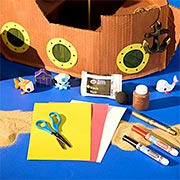
4. Choose materials that best portray the textures of each area. For instance, sandpaper is great for deserts or plateaus. Aluminum foil makes shiny water. Consider corrugated paper, cotton balls, and other items, too.


5. With Crayola Gel Markers, color in areas such as sky, evergreens, and coastline.


6. Using Crayola Scissors, cut out pieces of textured materials such as sandpaper, aluminum foil, or corrugated paper. Glue them in place on the landscape.


7. Gel Markers write on many surfaces. Color aluminum foil blue to represent water. Try these markers on sandpaper and other surfaces for a unique look.


8. Draw objects such as animals, grasses, wildlife, rocks, cacti, and mountain ranges with colored pencils on construction paper. Color them, cut them out, and glue on the bulletin board landscape.


9. Write labels for the landforms. Cut them out and glue in place. Invite your friends and families to see your magnificent display of what you learned about the Earth!


Safety Guidelines

Adult supervision is required for any arts & crafts project. Observe children closely and intervene as necessary to prevent potential safety problems and ensure appropriate use of arts and crafts materials. Some craft items, particularly beads and buttons, are potential choking hazards for young children. Avoid use of such small parts with children younger than 3 years. Craft items such as scissors, push pins and chenille sticks may have sharp points or edges. Avoid use of materials with sharp points by children younger than 4 years. Read all manufacturers' safety warnings before using arts and craft supplies.

Scissors—ATTENTION: The cutting edges of scissors are sharp and care should be taken whenever cutting or handling. Blunt-tip scissors should be used only by children 4 years and older. Pointed-tip scissors should be used only by children 6 years and older.

Adaptations

  • Research landforms to find out what animals use these areas as habitats in various climates.
  • Find out what plants are native to each landform. Identify locations on a world map.
  • Younger children and those with special needs might sketch their ideas before drawing them on the poster board. If possible, view as many local landforms as possible. Provide pictures and illustrations for reference.
  • Research the affects of global warming on the earth's landforms.

Related Lesson Plans

Lesson Plans

Share on Facebook

Supplies

crayola supplies
  • Erasable Colored Pencils
  • Gel Markers
  • No-Run School Glue
  • Pointed Tip Scissors
household supplies
  • aluminum foil
  • posterboard
  • sandpaper

Overview

grades

  • Grades 1 to 3
  • Grades 4 to 6
  • Special Needs

subjects

  • Science
  • Social Studies
  • Visual Arts

time

  • Multiple Sessions

benefits

  • Students identify various landforms found throughout the world.

  • Students understand the components and characteristics of each landform.

  • Students analyze various landforms and match them to textured materials, such as sandpaper to portray a desert.

  • Students create and label their own landscape bulletin board.

Cirriculum

Research Canada Standards
Research UK Standards
Research U.S. Standards