Big-Teeth Carnivorous Creatures

Why

Stick up for sharp-toothed creatures who get a bad rap! They are just trying to survive like all other animals.


Steps

1. Look closely at Edward Hicks’ "Peaceable Kingdom." Identify which animals are carnivorous and which are herbivorous. What is unusual about Hicks’ portrayal of these animals?


2. Brainstorm the names of carnivorous animals who have big teeth, such as sharks, lions, and wolves. All organisms need air, water, and food. Find out how the big, sharp-toothed animals grow, survive, move, and behave. Learn even more about your favorite big-teeth creature.


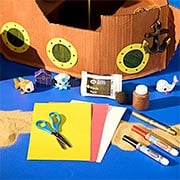
3. Use your imagination and Crayola Model Magic®, Washable Tempera Paint, and Tempera Mediums to create a model of your creature. Think of your own ideas, or follow these steps to create a shark!


4. Shape the body. Use hands to smooth and curve Model Magic into a shark. Look at photos to help you make it look realistic.


5. Pull out the face of your shark to form a beak-like mouth. Snip with scissors to open the mouth. Roll small balls and press on the sides of the head to form eyes. Flatten and cut triangular pieces for fins. Press and flatten the tail. Trim it into shape with Crayola Scissors. Press gills into the sides with a craft stick or plastic dinnerware.


6. To form your creature’s big, sharp teeth, use scissors and your fingertips to cut and pinch the Model Magic. Press the teeth into your creature’s mouth. If the Model Magic has started to dry, attach pieces with Crayola School Glue. Air-dry the shark for 24 hours.


7. Cover your painting area with newspaper. On a paper plate palette, mix paint colors to resemble the color of your shark. Mix Crayola Pearl It! Tempera Mixing Medium into the paint to give the shark a sheen. Paint the shark. Use just Pearl It! on your animal’s white teeth for a realistic look! Air-dry it overnight.


8. Display your creature with those created by your classmates. Share what you’ve learned about your these animals. Compare how they grow. What survival skills do they have in common?


Safety Guidelines

Adult supervision is required for any arts & crafts project. Observe children closely and intervene as necessary to prevent potential safety problems and ensure appropriate use of arts and crafts materials. Some craft items, particularly beads and buttons, are potential choking hazards for young children. Avoid use of such small parts with children younger than 3 years. Craft items such as scissors, push pins and chenille sticks may have sharp points or edges. Avoid use of materials with sharp points by children younger than 4 years. Read all manufacturers' safety warnings before using arts and craft supplies.

Crayola Modeling Materials including Crayola Model Magic®, and Model Magic Fusion™, Crayola Air-Dry Clay, and Crayola Dough—

  • Keep away from open flames. Do not use to make candleholders, hot plates, trivets, or other similar objects that will be used or placed near fire and other heat sources.
  • Do not put in an oven, microwave, or kiln.
  • Do not make into vessels/containers that will hold unpackaged food.
  • The use of modeling material to make items that look like food is discouraged for children younger than age 5 to avoid their confusion with real food.
  • Unless sealed with a water-resistant glaze, do not make projects exposed to or immersed in water, such as boats or outdoor bird feeders. They would disintegrate when exposed to moisture.
  • Crayola Dough—contains gluten (wheat flour) as an ingredient.
  • Crayola Air-Dry Clay, Crayola Model Magic and Model Magic Fusion are gluten-free. However, they are produced on the same machinery as Crayola Dough which does contain gluten. Although the machines are cleaned prior to the start of each production run, there is a slight possibility that trace amounts of gluten from Crayola Dough may be present in the other modeling compound products. For information regarding specific ingredients or allergic concerns, please call our Consumer Affairs department at 1-800-272-9652 weekdays between 9 AM and 4 PM Eastern Standard Time.

Crayola Washable Paints—Not for use as body/face paint.

Scissors—ATTENTION: The cutting edges of scissors are sharp and care should be taken whenever cutting or handling. Blunt-tip scissors should be used only by children 4 years and older. Pointed-tip scissors should be used only by children 6 years and older.

Wood—By its nature, wood is rough and may contain splinters or sharp points

Adaptations

  • Visit a local aquarium, zoo, or nature preserve to see carnivorous creatures up close. Learn more about your animal’s survival skills and behaviors.
  • Chart information about the creatures selected by the whole class. Indicate where they live (ocean, desert, rainforest) and what they eat. Note their sizes, how fast they move, and other details. How could you help others learn more about these creatures? Write reports, create an animal action newsletter, or make informational posters to publish what you’ve learned.
  • Assessment: Assess learning by creating "What I Know" cards. Before beginning research on animals, invite students to write down what they already know about the creature on index cards. After completing this activity, provide a second set of cards for children to record all of the new information they’ve discovered. Children with writing challenges can record their words verbally, use the computer, or talk with the teacher.

Related Lesson Plans

Lesson Plans

Share on Facebook

Supplies

crayola supplies
  • Artista II® Washable Tempera Paint
  • Arts & Crafts Brushes
  • Model Magic®
  • No-Run School Glue
  • Pointed Tip Scissors
  • Tempera Mixing Mediums
household supplies
  • recycled newspaper
  • Party Express paper plates
  • craft stick or plastic dinnerware
  • paper towels
  • container(s) of water

Overview

grades

  • Grades 1 to 3
  • Grades 4 to 6

subjects

  • Science
  • Visual Arts

time

  • Multiple Sessions

benefits

  • Children research the survival skills of carnivorous animals with large teeth.

  • Children build a realistic model of a carnivorous creature.

  • Children compare and contrast how their carnivorous creatures grow, survive, move, and behave.

Cirriculum

Research Canada Standards
Research UK Standards
Research U.S. Standards