Design Your School

Why

Imagine a school that’s 30 stories high, maybe with skateboard ramps between each floor. Design your own extraordinary school—a sphere in space perhaps—and then make a model!


Steps

1. Curious kids sometimes wonder how school buildings have changed. You could interview older family members or invite them to visit your class to describe their long-ago school building. Visit a one-room schoolhouse or museum with a replica of one.


2. Take a walk around the exterior of your school. Notice the way it was designed. How many stories, windows in each room, wings, doors? Discuss schools in the past and present. Brainstorm possible improvements for future schools. Create a Venn diagram that compares and contrasts schools of the past, present, and future.


3. Enjoy reading Sideways Stories From Wayside School. Discuss the reason for the title of the book, and the 30 characters described in the 30 chapters. Here are some suggestions for how to make a 30-story Wayside School. Use these ideas to create your own model school building. You’re the architect!


4. Build the structure. Flatten the tops of two clean, half-gallon cardboard drink cartons. Attach one on top of the other with masking tape.


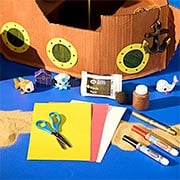
5. Use Crayola® Scissors to cut large construction paper to fit around the containers. With a straight edge, use Crayola Erasable Colored Pencils to draw evenly spaced lines for the 30 rows of windows. Use Crayola Gel Markers to draw the windows and doors.


6. Make students. To make the children (maybe you and your classmates), accordion-fold three pieces of white paper as if to make tiny paper dolls. Draw one set of paper dolls with an arm uplifted, another set with both arms down, and another with arms and legs outstretched. Cut figures out and then cut them apart.


7. Add features and color each student with Crayola Washable Markers, Fine Tip Markers, and Multicultural Markers. Most of the figures will be visible from the waist up and a few will be viewed from the back, so cut and decorate them accordingly. Use Crayola School Glue to attach the figures so they look like they’re in the windows.


8. Draw, color, and cut paper kites and balloons. Glue them to the children’s uplifted arms. Erase any extra marks from drawing the 30 stories. Glue the building exterior to the cartons. Air-dry.


9. Add a roof, clouds, and greenery. Cut and glue on a posterboard roof. Add clouds by fluffing out cotton balls and securely gluing them to the roof.


10. Glue green construction paper to cardboard for a base. Air-dry the base.


11. Draw and color sidewalks leading to the front door. Create bushes and trees using markers on white paper. Include a tab on the bottom. Cut and glue in place. Air-dry your school.


Safety Guidelines

Adult supervision is required for any arts & crafts project. Observe children closely and intervene as necessary to prevent potential safety problems and ensure appropriate use of arts and crafts materials. Some craft items, particularly beads and buttons, are potential choking hazards for young children. Avoid use of such small parts with children younger than 3 years. Craft items such as scissors, push pins and chenille sticks may have sharp points or edges. Avoid use of materials with sharp points by children younger than 4 years. Read all manufacturers' safety warnings before using arts and craft supplies.

Scissors—ATTENTION: The cutting edges of scissors are sharp and care should be taken whenever cutting or handling. Blunt-tip scissors should be used only by children 4 years and older. Pointed-tip scissors should be used only by children 6 years and older.

Adaptations

  • After discussing the situations and characters portrayed in the book, make a list of positive values stressed by the author. Work with classmates to draw, color, and cut out large characters from the book. Post them around your room with speech balloons expressing the values you listed.
  • Start a chain story about an imaginary day at your school. Include personalities from your school such as students, teachers, principal, secretary, custodian, and aides. Have each classmate add to the story after reading what was written before. Ask a parent volunteer to type it if it is not already done on a computer. Add illustrations. Enjoy reading the story together. Place a copy in the school library.
  • After designing and building your school, use your imagination to create an extraordinary playground to go with it.

Related Lesson Plans

Lesson Plans

Share on Facebook

Supplies

crayola supplies
  • Fine Line Markers
  • Erasable Colored Pencils
  • Markers
  • Multicultural Markers
  • Gel Markers
  • No-Run School Glue
  • Pointed Tip Scissors
  • Construction Paper
household supplies
  • recycled boxes
  • posterboard
  • masking tape
  • cardboard
  • cotton balls
  • straight edge

Overview

grades

  • Grades 4 to 6
  • Grades 1 to 3

subjects

  • Language Arts
  • Social Studies
  • Visual Arts

time

  • 30 to 60 minutes
  • Multiple Sessions

benefits

  • Students research the schools of yesterday, today, and the future, and then compare and contrast what they have learned.

  • Students read a book by Louis Sachar and discuss information and human values presented by this writer of humorous, offbeat literature.

  • Students use recycled materials to represent their own ideas of a school building.

Cirriculum

Research Canada Standards
Research UK Standards
Research U.S. Standards