Earthquake Detector
Research earthquakes and how they are detected and measured then make your own simulated seismograph.
1. Research the earth processes that result in earthquakes. Look at maps to determine where earthquakes occur frequently. Locate recent earthquakes and find their magnitude. Investigate the science of earthquake detection, including seismographs and the Richter magnitude scale.
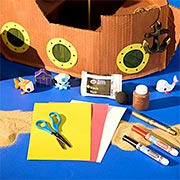
2. Work in teams of two or three to build a replica of an earthquake detector. Remove the lid from a shoebox. Use a ruler and Crayola® Scissors to cut 4-inch (10 cm) slits in the bottom edges of the two long sides of the box. Ask an adult if you need help to cut or align the slits across from each other.
3. Cut paper into strips slightly smaller than 4 inches (10 cm) wide. Attach pieces together with clear adhesive tape to form a long strip. Insert the strip of paper into the slits so the ends of the strip extend out of the slits.
4. Attach two rubber bands around the box so the bands are stretched wide to the sides of the other two slits. Place a Crayola Fine Line Marker between the two rubber bands. Cut two pieces of yarn with scissors and tie the marker into place between the rubber bands so the tip lightly rests on the strip of paper in the box.
5. Work together with one partner jiggling the box and the other pulling the paper through to get a continuous reading of the magnitude of the simulated earthquake. Experiment with your own ideas for improving the design of your earthquake detector.
Adult supervision is required for any arts & crafts project. Observe children closely and intervene as necessary to prevent potential safety problems and ensure appropriate use of arts and crafts materials. Some craft items, particularly beads and buttons, are potential choking hazards for young children. Avoid use of such small parts with children younger than 3 years. Craft items such as scissors, push pins and chenille sticks may have sharp points or edges. Avoid use of materials with sharp points by children younger than 4 years. Read all manufacturers' safety warnings before using arts and craft supplies.
Scissors—ATTENTION: The cutting edges of scissors are sharp and care should be taken whenever cutting or handling. Blunt-tip scissors should be used only by children 4 years and older. Pointed-tip scissors should be used only by children 6 years and older.
String-Like Materials—Includes string, raffia, lacing, yarn, ribbon, and other similar material. Children 3 years and younger should not be given any string-like material that is longer than 12 inches. Close adult supervision is essential whenever children use string-like material. When crafts are to be worn around the necks of children 8 years and younger, attach the ends of the “string-like material” with clear adhesive tape, which allows easy release of the bond if the craft becomes entangled or caught on equipment. For children older than 8 years, the ends of the “string-like material” may be tied and knotted.
- Cover the sides of your earthquake detector with colorful information about earthquakes. Describe the earth processes that work to cause earthquakes. Include diagrams.
- Charles Richter, the inventor of the Richter Scale tool to measure earthquakes, was born on April 26, 1900, near Hamilton, Ohio. Find out how he invented this tool. Older students research the mathematical calculations used to determine Richter magnitudes.
- Select an earthquake in an area or time period you are studying. Research details including rescue efforts, extent of damage, building code changes as a result, and other facts about the earthquake. Find out about research to predict when earthquakes might occur. Practice safety procedures to follow if earthquakes are common in your area.