
Magical Math-ical Dragon
Storytelling meets math when you write stories in which your hero is a magical, math-ical dragon!
1. Read picture books and stories such as Sir Cumference and the Dragon of Pi in which mathematics and solutions to math problems play an important role in the action.
2. Discuss how the author creatively used math operations, vocabulary, and problem solving to tell a story. Talk about important characters and their roles in the action.
3. Create your own magical, math-ical story about a dragon or other fantasy character. Choose a math concept (addition, multiplication, fractions, measurement, or money, for example) and think of clever names for the main and secondary characters.
4. Use Crayola® Erasable Colored Pencils to draft, revise, and edit your magical, math-ical story. If you change your mind, just erase the words and rewrite!
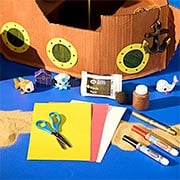
5. Use your imagination to create a poster showing your main character. To make a dragon, cut craft foil into the shape of a dragon using Crayola Scissors.
6. Attach the foil dragon to dark paper with a Crayola Glue Stick.
7. Use Crayola Gel Markers to add details to your dragon’s face, back, feet, wings, and tail.
8. Cut oval scales from foil. Color each scale a different color with Gel Markers. Glue to the dragon’s body.
9. Use an Erasable Colored Pencil to add fine detail to the Gel Marker colored areas. The pencil tip will gently scratch away some of the marker color so you can add math symbols, numerals, and shapes.
10. Share your magical, math-ical story and dragon with classmates.
Adult supervision is required for any arts & crafts project. Observe children closely and intervene as necessary to prevent potential safety problems and ensure appropriate use of arts and crafts materials. Some craft items, particularly beads and buttons, are potential choking hazards for young children. Avoid use of such small parts with children younger than 3 years. Craft items such as scissors, push pins and chenille sticks may have sharp points or edges. Avoid use of materials with sharp points by children younger than 4 years. Read all manufacturers' safety warnings before using arts and craft supplies.
Scissors—ATTENTION: The cutting edges of scissors are sharp and care should be taken whenever cutting or handling. Blunt-tip scissors should be used only by children 4 years and older. Pointed-tip scissors should be used only by children 6 years and older.
- Include this math lesson as part of a celebration of Chinese New Year or the Chinese Dragon Boat Festival. Attach two rulers or dowel sticks to the sides of dragon pictures so they can be carried as banners in a dragon parade.
- Integrate literature into math throughout the school year. Share Sir Cumference and similar books to stimulate problem-solving, writing, and art activities.