Off-to-School Bus

Why

What do you need to know to be a safe bus rider? Create your own school bus, driver, and passengers!


Steps

1. If this is your first time to ride a school bus, what do think the trip will be like? If you have ridden the school bus, what do you remember most about riding it? What do you like to do on the bus?


2. What are the safety rules for riding on your school bus? What rules do drivers follow? Why do you think there are so many rules? Where is the Danger Zone?


3. School buses are made as safe as they can be. Look at pictures of people going to school long ago. Ask your parents about their bus experiences. What has changed?


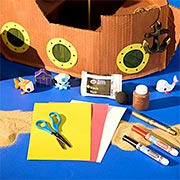
4. To make your own school bus, cover your art area with newspapers. Paint the outside and inside of a shoe box with Crayola® Washable Paint using a Crayola Paint Brush. Dry.


5. Create passengers on your school bus with Crayola Model Magic. Shape the driver and school children. Dry overnight.


6. With Crayola Washable Markers, add details to the bus including doors, windows, wheels, and lights.


7. Ask an adult to help you cut out windows and doors with Crayola Scissors.


8. Climb aboard! Practice following safety rules so you get to and from school safely every time.


Safety Guidelines

Adult supervision is required for any arts & crafts project. Observe children closely and intervene as necessary to prevent potential safety problems and ensure appropriate use of arts and crafts materials. Some craft items, particularly beads and buttons, are potential choking hazards for young children. Avoid use of such small parts with children younger than 3 years. Craft items such as scissors, push pins and chenille sticks may have sharp points or edges. Avoid use of materials with sharp points by children younger than 4 years. Read all manufacturers' safety warnings before using arts and craft supplies.

Crayola Modeling Materials including Crayola Model Magic®, and Model Magic Fusion™, Crayola Air-Dry Clay, and Crayola Dough—

  • Keep away from open flames. Do not use to make candleholders, hot plates, trivets, or other similar objects that will be used or placed near fire and other heat sources.
  • Do not put in an oven, microwave, or kiln.
  • Do not make into vessels/containers that will hold unpackaged food.
  • The use of modeling material to make items that look like food is discouraged for children younger than age 5 to avoid their confusion with real food.
  • Unless sealed with a water-resistant glaze, do not make projects exposed to or immersed in water, such as boats or outdoor bird feeders. They would disintegrate when exposed to moisture.
  • Crayola Dough—contains gluten (wheat flour) as an ingredient.
  • Crayola Air-Dry Clay, Crayola Model Magic and Model Magic Fusion are gluten-free. However, they are produced on the same machinery as Crayola Dough which does contain gluten. Although the machines are cleaned prior to the start of each production run, there is a slight possibility that trace amounts of gluten from Crayola Dough may be present in the other modeling compound products. For information regarding specific ingredients or allergic concerns, please call our Consumer Affairs department at 1-800-272-9652 weekdays between 9 AM and 4 PM Eastern Standard Time.

Crayola Washable Paints—Not for use as body/face paint.

Scissors—ATTENTION: The cutting edges of scissors are sharp and care should be taken whenever cutting or handling. Blunt-tip scissors should be used only by children 4 years and older. Pointed-tip scissors should be used only by children 6 years and older.

Adaptations

  • Research ways children around the world get to school. Find out what countries rely on rickshaws, city buses, and other means for school transport.
  • Older students debate the need for seat belts in school buses, pro and con.
  • On separate paper, draw the danger zone to fit underneath the school bus.
  • For children with special needs, create a bus buddy program.

Related Lesson Plans

Lesson Plans

Share on Facebook

Supplies

crayola supplies
  • Paint Brushes
  • Markers
  • Washable Kid's Paint
  • Model Magic®
  • Blunt-Tip Scissors
household supplies
  • recycled newspaper
  • shoe box
  • recycled boxes
  • paper towels
  • container(s) of water

Overview

grades

  • Grades 1 to 3
  • Special Needs

subjects

  • Language Arts
  • Social Studies

time

  • 30 to 60 minutes
  • Multiple Sessions

benefits

  • Students explore what school buses look like and their uses.

  • Students find out about school bus safety, including the Danger Zone.

  • Children represent the roles of the school bus, its driver, and themselves as passengers in creating a safe community.

Cirriculum

Research Canada Standards
Research UK Standards
Research U.S. Standards