Save the Sphinx!
Egypt’s Great Sphinx may be the original lion king! Join archaeologists working to conserve this amazing ancient monument.
1. Explore the ancient Egyptian treasure, the Great Sphinx. The 4,500-year-old monument has a king’s head and a lion’s body. Find out what it was made of and how it was constructed. What were the builders’ challenges? Look at several paintings and pictures. Use Crayola® Erasable Colored Pencils to sketch the Great Sphinx from different angles and in detail. To make corrections, just erase!
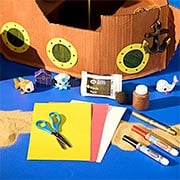
2. You’re the builder! Plan how to construct a model of the Great Sphinx. Will you build it as it looked originally or as it looks today? This is how we built our replica, but you may have other ideas.
3. Shape your Sphinx. Construct a base (armature) using small boxes and balls of newspaper. Tape pieces in place. Layer white Crayola Model Magic over the armature. Add a face, headdress, beard, and other details. Use a craft stick to make fine lines. Texture the structure with a comb or other tool. Air-dry your sphinx overnight.
4. Paint the sculpture. Cover your art area with newspaper. Mix gold, white, and brown Crayola Premier Tempera to get an authentic limestone color. Paint the Sphinx with Crayola Brushes. Air-dry the paint.
5. Save the Sphinx! The Great Sphinx is not faring very well today. Investigate how the environment and human behavior has affected the monument. If you were an anthropologist, how would you recommend saving the Sphinx? Write your ideas on cards and display them with your model. Share what you’re learning with other students.
Adult supervision is required for any arts & crafts project. Observe children closely and intervene as necessary to prevent potential safety problems and ensure appropriate use of arts and crafts materials. Some craft items, particularly beads and buttons, are potential choking hazards for young children. Avoid use of such small parts with children younger than 3 years. Craft items such as scissors, push pins and chenille sticks may have sharp points or edges. Avoid use of materials with sharp points by children younger than 4 years. Read all manufacturers' safety warnings before using arts and craft supplies.
Crayola Modeling Materials including Crayola Model Magic®, and Model Magic Fusion™, Crayola Air-Dry Clay, and Crayola Dough—
- Keep away from open flames. Do not use to make candleholders, hot plates, trivets, or other similar objects that will be used or placed near fire and other heat sources.
- Do not put in an oven, microwave, or kiln.
- Do not make into vessels/containers that will hold unpackaged food.
- The use of modeling material to make items that look like food is discouraged for children younger than age 5 to avoid their confusion with real food.
- Unless sealed with a water-resistant glaze, do not make projects exposed to or immersed in water, such as boats or outdoor bird feeders. They would disintegrate when exposed to moisture.
- Crayola Dough—contains gluten (wheat flour) as an ingredient.
- Crayola Air-Dry Clay, Crayola Model Magic and Model Magic Fusion are gluten-free. However, they are produced on the same machinery as Crayola Dough which does contain gluten. Although the machines are cleaned prior to the start of each production run, there is a slight possibility that trace amounts of gluten from Crayola Dough may be present in the other modeling compound products. For information regarding specific ingredients or allergic concerns, please call our Consumer Affairs department at 1-800-272-9652 weekdays between 9 AM and 4 PM Eastern Standard Time.
Crayola Washable Paints—Not for use as body/face paint.
Recycled Foam Produce Trays—Wash in hot, soapy water. No meat or poultry trays should be used.
Wood—By its nature, wood is rough and may contain splinters or sharp points
- Younger children and those with special needs may benefit from working in pairs or groups. When planning the model, identify who will be responsible for each part of the effort.
- To make a pedestal for the Great Sphinx, use a recycled foam produce tray. Write on it with Crayola Gel Markers.
- On a map, plot the location of the Great Sphinx in relationship to the pyramids. Find Egypt on a map of Africa and identify where these structures are found in the country.
- What is limestone? Identify other natural and sculpted limestone treasures. How have environmental and human factors transformed them? Explore other efforts to preserve, protect, and rebuild monuments.
- Assessment: Observe accuracy of sculpture. Look for original, ingenious preservation ideas.