Silk Road Treasures & Traders
Trace the 7,000-mile-long Silk Road with traders and their camels. Imagine traveling across the treacherous mountains, deserts, and steppes, yesterday and today.
1. The Silk Road meandered from Chang'an, China, to the shores of the eastern Mediterranean. Marco Polo, Alexander the Great, and other famous men are associated with it. Bandits and rough terrain made the trip extremely dangerous to camel caravans. Why, then, was this trading route used for so long, from about the 4th century BCE until the 14th century?
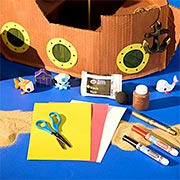
2. Research to find out what key roles the Silk Road played in shaping world history. What products were carried back and forth? How long did it take to travel? How were people’s lives influenced? Find maps that show the numerous parts of the Silk Road. Show what you learned with a diorama such as the one shown here.
3. With Crayola® Scissors, cut construction paper to cover a box. Attach the paper to the box with Crayola School Glue. Air-dry the glue.
4. With Crayola Markers, sketch a map showing part or all of the Silk Road. Color the various routes, names of continents or countries, and other details.
5. Mold camels with Crayola Neon Model Magic. When Model Magic is fresh from the pack it sticks to itself. Add colorful rugs on the camels’ backs. Fill their baskets with treasures such as gold and silk. Air-dry the camels overnight.
6. Glue camels on the map. Air-dry the diorama before you present information about the Silk Road to your classmates.
Adult supervision is required for any arts & crafts project. Observe children closely and intervene as necessary to prevent potential safety problems and ensure appropriate use of arts and crafts materials. Some craft items, particularly beads and buttons, are potential choking hazards for young children. Avoid use of such small parts with children younger than 3 years. Craft items such as scissors, push pins and chenille sticks may have sharp points or edges. Avoid use of materials with sharp points by children younger than 4 years. Read all manufacturers' safety warnings before using arts and craft supplies.
Crayola Modeling Materials including Crayola Model Magic®, and Model Magic Fusion™, Crayola Air-Dry Clay, and Crayola Dough—
- Keep away from open flames. Do not use to make candleholders, hot plates, trivets, or other similar objects that will be used or placed near fire and other heat sources.
- Do not put in an oven, microwave, or kiln.
- Do not make into vessels/containers that will hold unpackaged food.
- The use of modeling material to make items that look like food is discouraged for children younger than age 5 to avoid their confusion with real food.
- Unless sealed with a water-resistant glaze, do not make projects exposed to or immersed in water, such as boats or outdoor bird feeders. They would disintegrate when exposed to moisture.
- Crayola Dough—contains gluten (wheat flour) as an ingredient.
- Crayola Air-Dry Clay, Crayola Model Magic and Model Magic Fusion are gluten-free. However, they are produced on the same machinery as Crayola Dough which does contain gluten. Although the machines are cleaned prior to the start of each production run, there is a slight possibility that trace amounts of gluten from Crayola Dough may be present in the other modeling compound products. For information regarding specific ingredients or allergic concerns, please call our Consumer Affairs department at 1-800-272-9652 weekdays between 9 AM and 4 PM Eastern Standard Time.
Scissors—ATTENTION: The cutting edges of scissors are sharp and care should be taken whenever cutting or handling. Blunt-tip scissors should be used only by children 4 years and older. Pointed-tip scissors should be used only by children 6 years and older.
- Recreate the entire Silk Road on a mural. Include all the products that may have been traded and show the varied routes that ancient merchants took.
- Write an imaginary journal of a trip along a portion of the Silk Road, either historic or contemporary. What people do you meet? What do they eat? How do they dress? What could you trade with them?
- The Ancient Chinese are known for their many inventions and technological advancements including calendars, gunpowder, printing, silk, papermaking, and the compass. The earliest book was printed in 868. In teams, research Chinese inventions and present information about each in a graphic format.
- Research the Silk Road Project started by cellist Yo-Yo Ma and others to promote the cultures and traditions of the countries that lie along the path of this ancient trade route. Find out about the Silk Road Pipeline. Learn more about each country today that is located along the route and efforts to restore it as a tourist expedition.
- Assessment: Analyze the complexity of children’s graphic and oral presentations. Look for accurate, interesting details.