Star Gazer

Why

Display facts about the stars on a unique telescope replica.


Steps

1. Work with a small group of classmates to create a K-W-L chart about stars. Include what you Know, what you Want to know, and (after doing research), what you Learned. Predict and research distances from Earth to each star, including the sun. Record your estimates, ideas, and findings on poster board with Crayola® Metallic Crayons or Metallic Colored Pencils.


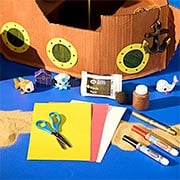
2. To make a Star Gazer telescope to display facts about stars, measure bands of colorful construction paper to fit around a recycled cardboard tube. Cut bands with Crayola Scissors.


3. Use Crayola Metallic Crayons or Metallic Colored Pencils to write facts about stars on each band. Attach bands in alternating colors onto the cardboard tube with a Crayola Washable Glue Stick.


4. Cut a thin strip of construction paper. Fold strip in half, then in half again. Open and reverse one fold to arrange strip into a three-dimensional square loop. Glue the ends together. Glue inside one end of the tube. Fold loop out to make the end of your stargazer telescope.


Safety Guidelines

Adult supervision is required for any arts & crafts project. Observe children closely and intervene as necessary to prevent potential safety problems and ensure appropriate use of arts and crafts materials. Some craft items, particularly beads and buttons, are potential choking hazards for young children. Avoid use of such small parts with children younger than 3 years. Craft items such as scissors, push pins and chenille sticks may have sharp points or edges. Avoid use of materials with sharp points by children younger than 4 years. Read all manufacturers' safety warnings before using arts and craft supplies.

Recycled Cardboard Tubes—Use paper towel tubes, gift-wrap tubes, or long cardboard tubes that can be cut to any length. Health professionals caution against using recycled toilet paper tubes for arts & crafts projects because of the potential fecal contamination.

Scissors—ATTENTION: The cutting edges of scissors are sharp and care should be taken whenever cutting or handling. Blunt-tip scissors should be used only by children 4 years and older. Pointed-tip scissors should be used only by children 6 years and older.

Adaptations

  • Take your stargazer telescopes with you to a local planetarium for an unforgettable tour through the solar system, Milky Way galaxy, and to the limits of the visible universe.
  • Generate a list of simple facts about stars. Cut star shapes, then fill each shape with words to complete the phrase "Stars are...." Fill a hallway wall with stars.
  • Track the path of stars across the sky for several months. Sketch major constellations in the night sky once a month from the same location and facing the same direction. Compare each month's sketches.
  • Younger children and special needs students can work in pairs to find facts and build telescopes. Pre-writers can add pictures to bands or paper to demonstrate what they've learned about stars from classroom experiences.

Related Lesson Plans

Lesson Plans

Share on Facebook

Supplies

crayola supplies
  • Metallic FX Crayons
  • Metallic Colored Pencils
  • Glue Sticks
  • Pointed Tip Scissors
  • Construction Paper
household supplies
  • recycled gift wrap or paper towel roll

Overview

grades

  • Grades 1 to 3
  • Grades 4 to 6
  • Special Needs

subjects

  • Language Arts
  • Math
  • Science
  • Visual Arts

time

  • 30 to 60 minutes
  • Multiple Sessions

benefits

  • Students use a variety of electronic and library resources to investigate information about stars.

  • Students record their ideas and facts researched on a K-W-L chart, recognizing that there are many far-away stars in addition to the sun.

  • Children create unique 3-dimensional displays to demonstrate their knowledge about stars.

Cirriculum

Research Canada Standards
Research UK Standards
Research U.S. Standards