Trade Route Timeline
Travel ancient trade routes! What products were exchanged? Where were the major ports? How did traders cross land? Show these routes on a map.
1. The Silk Road is one of the most famous trade routes. It was 700 miles long and spanned from China to the Roman Empires. The Chinese traded their silk for metals, precious stones, medicines, furs, and perfumes.
2. The Incense Route was another ancient trade route where fragrances such as frankincense and myrrh and spices, gold, ivory, and precious stones were brought from southern Arabia, Ethiopia, and Somalia to the Roman market. The Tin and Amber Routes were also ancient trade routes.
3. Research and locate these and other ancient trade routes. What products were traded? What methods of transportation were available? When were these routes used?
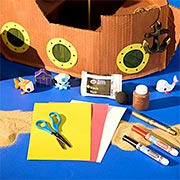
4. Use Crayola® Washable Markers to draw a map covering several trade route areas on white posterboard. Use a Peters Projection map as a reference to make sure your areas are accurately sized.
5. With different colors of yarn, diagram each trade route you researched. Include a key to identify the yarn color used for each trade route, dates the routes were used, and the map's scale.
6. Shape Crayola Model Magic into replicas of some of the trade goods. Cover your art area with newspaper. Paint the items in authentic colors with Crayola Tempera and Paint Brushes. Dry.
7. Draw other trade goods with Crayola Crayons and Colored Pencils on fabric scraps or paper. Cut them out with Crayola Scissors.
8. Use Crayola School Glue to attach your trade goods to your Trade Route Timeline. Dry.
Adult supervision is required for any arts & crafts project. Observe children closely and intervene as necessary to prevent potential safety problems and ensure appropriate use of arts and crafts materials. Some craft items, particularly beads and buttons, are potential choking hazards for young children. Avoid use of such small parts with children younger than 3 years. Craft items such as scissors, push pins and chenille sticks may have sharp points or edges. Avoid use of materials with sharp points by children younger than 4 years. Read all manufacturers' safety warnings before using arts and craft supplies.
Crayola Modeling Materials including Crayola Model Magic®, and Model Magic Fusion™, Crayola Air-Dry Clay, and Crayola Dough—
- Keep away from open flames. Do not use to make candleholders, hot plates, trivets, or other similar objects that will be used or placed near fire and other heat sources.
- Do not put in an oven, microwave, or kiln.
- Do not make into vessels/containers that will hold unpackaged food.
- The use of modeling material to make items that look like food is discouraged for children younger than age 5 to avoid their confusion with real food.
- Unless sealed with a water-resistant glaze, do not make projects exposed to or immersed in water, such as boats or outdoor bird feeders. They would disintegrate when exposed to moisture.
- Crayola Dough—contains gluten (wheat flour) as an ingredient.
- Crayola Air-Dry Clay, Crayola Model Magic and Model Magic Fusion are gluten-free. However, they are produced on the same machinery as Crayola Dough which does contain gluten. Although the machines are cleaned prior to the start of each production run, there is a slight possibility that trace amounts of gluten from Crayola Dough may be present in the other modeling compound products. For information regarding specific ingredients or allergic concerns, please call our Consumer Affairs department at 1-800-272-9652 weekdays between 9 AM and 4 PM Eastern Standard Time.
Crayola Washable Paints—Not for use as body/face paint.
Scissors—ATTENTION: The cutting edges of scissors are sharp and care should be taken whenever cutting or handling. Blunt-tip scissors should be used only by children 4 years and older. Pointed-tip scissors should be used only by children 6 years and older.
String-Like Materials—Includes string, raffia, lacing, yarn, ribbon, and other similar material. Children 3 years and younger should not be given any string-like material that is longer than 12 inches. Close adult supervision is essential whenever children use string-like material. When crafts are to be worn around the necks of children 8 years and younger, attach the ends of the “string-like material” with clear adhesive tape, which allows easy release of the bond if the craft becomes entangled or caught on equipment. For children older than 8 years, the ends of the “string-like material” may be tied and knotted.
- With a friend, pretend you are two travelers on one of the trade routes. Act out different situations you could have encountered.
- Set up a system of trade in your classroom. Discuss which objects you will trade. Make a trading post to implement your system.
- Compare ancient trade routes to commerce today. What products are exchanged? How are they moved?
- Vasco da Gama found the first sea route from Europe to India around the southern tip of Africa in 1497. How did this change trade?