Skip to Main Content

Lesson Plans

Spark creativity with Crayola lesson plans. With hundreds of activities, the learning possibilities are endless. 

In The Hour

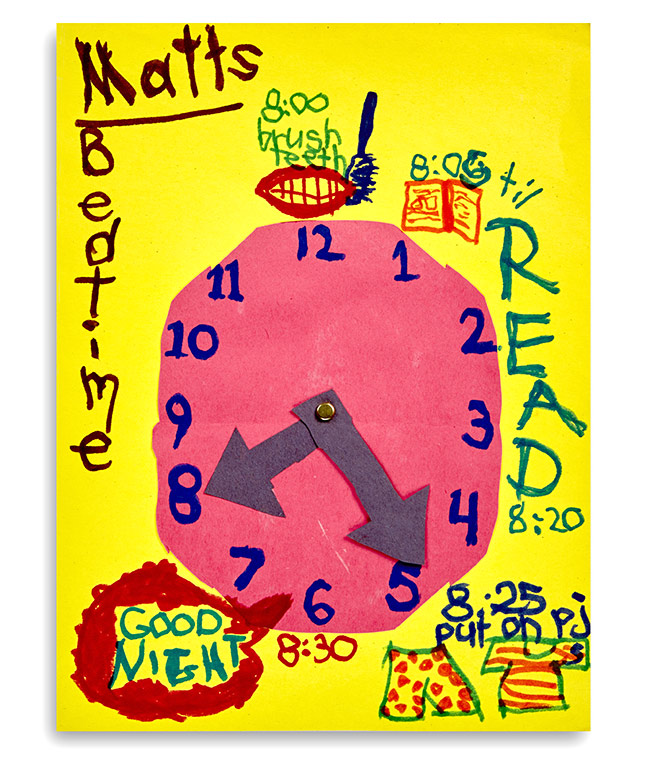
Students will create an analog clock with movable parts and illustrate various activities that occur during one hour of a typical day.

Lesson Plan

Supplies Needed

Gather all the supplies needed to bring your craft ideas to life! From paints and markers to glue and scissors, our crafts section has everything to spark creativity and make every project truly special.

Steps

  • Step 1

    Begin by reviewing telling time on an analog clock. Make sure students understand a.m., p.m., hour hand, minute hand, increments of five, division of 60, etc. Ask students to think about their daily rituals or activities and which hour each wants to focus on for their project.

  • Step 2

    Have students create an analog clock. They can trace a circle onto construction paper and then cut it out. Then have them add the clock face numerals. Encourage them to place the 12, 6, 3, and 9 first and then fill in the others using visual division skills. Next have them cut out two arrows, one shorter than the other, and then attach them in the center of the clock using a paper fastener/brad.

  • Step 3

    Now ask students to illustrate the hour they selected. Have them think about how long it takes to perform every activity in that 60-minute period. For example, if they choose the morning they might arise at 7:10, make their bed at 7:11, get dressed at 7:13, brush their teeth at 7:18, eat breakfast at 7:20, and get on the school bus at 7:45. Now have them glue their clocks (with the attached hands) onto a piece of poster board and illustrate the activities noting the times in digital format along side the clock.

  • Step 4

    Have students present their clocks and hour of activities. As they describe each activity, have them move the hands on the clock to the correct position, even when the time increments are smaller than five minutes.

Standards

MATH: Tell and write time in hours and half-hours using analog and digital clocks.

MATH: Elicit evidence of thinking about time as a measurement.

Adaptations

Dictate a time to the class. Ask students to depict it by drawing an analog clock at the top of a piece of paper and then illustrating what they might be doing at that hour in the night or morning on one side of the page, and what they might be doing at that hour in the afternoon or evening on the other side of the page.

Have students research what time it is in other countries. Start with nations that are represented by your school population or where students have relatives living, in order to add personal and community relevance. Extend the exploration to include countries that are in the news to make current events more understandable. Students will quickly realize that while they were sleeping, others around the world were awake and making important decisions that they can follow in today's news.