Skip to Main Content

Lesson Plans

Spark creativity with Crayola lesson plans. With hundreds of activities, the learning possibilities are endless. 

Near & Far

Students will learn about creating realistic depth perception in art.

Lesson Plan

Supplies Needed

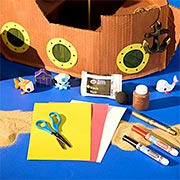
Gather all the supplies needed to bring your craft ideas to life! From paints and markers to glue and scissors, our crafts section has everything to spark creativity and make every project truly special.

Steps

  • Step 1

    Depth perception is how we see and understand the distance between objects. Explain that artists use various techniques to make flat images look like they have depth and distance. They might use atmospheric perspective, where objects that are farther away are depicted in lighter colors and fewer details, or they might overlap one item over another to show that it's closer because it's blocking another object. But a major technique is using the vanishing point in linear perspective, where objects get smaller and lines appear to converge to create the sense of depth.

  • Step 2

    Have students look at some artwork images that use a linear perspective technique. A famous example is "The Hunt in the Forest" (1470) by Paolo Uccello, where the stream at the right guides our eyes into the distance, and the receding scale of the dogs and horses from the foreground to the background conveys the depth and distance.

  • Step 3

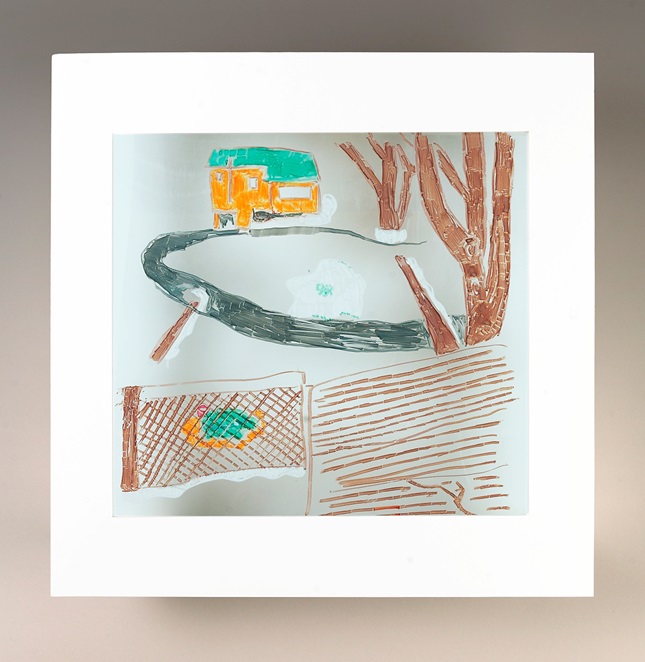
    Ask students to use window markers to outline images they see in the window. Have them note that objects in the foreground might be small but appear to be large because they're closer to the window. (These Crayola products will easily wash off the windows.)

  • Step 4

    Next ask students to create a drawing using a vanishing point technique. They might draw railroad tracks that start wide in the foreground but narrow in the distance or a dock protruding out from the shore that seems to come to a point in the ocean in the distance. Have them present and discuss the technique of creating realistic looking landscapes.

Standards

ARTS: Speculate about processes an artist uses to create a work of art. 

MATH: Use mathematics and computational thinking to analyze and create visual relationships and measurements in illustrations. 

Adaptations

Humans have binocular vision. Our eyes are both forward facing, which gives us depth perception abilities. Some animals, such as rabbits, birds of prey, some reptiles, and ungulates (hoofed animals), and others, have eyes on either side of their head, which gives them monocular vision. Have students investigate how this benefits the animals. For example, some have a field of view of nearly 360 degrees around their head so they can easily spot predators.

Two functioning forward facing eyes are needed to be able to judge depth. Have students test this binocular vision by holding two pencils, one in each hand, facing each other at arm's length. With one eye closed, try to touch the ends of the pencils together, then try again with both eyes open.