Skip to Main Content

Lesson Plans

Spark creativity with Crayola lesson plans. With hundreds of activities, the learning possibilities are endless. 

Women's History on the Table

Judy Chicago is an artist known for her works commemorating women in history. Students will explore "The Dinner Party," Chicago's installation consisting of place settings for mythical and historical women, then create their own place settings to honor women in history.

Lesson Plan

Supplies Needed

Gather all the supplies needed to bring your craft ideas to life! From paints and markers to glue and scissors, our crafts section has everything to spark creativity and make every project truly special.

Steps

  • Step 1

    Judy Chicago (b. 1939) is an American artist and art educator. In the 1970s she founded the first feminist art program in the U.S. at California State University, Fresno. Have students learn about her most well-known work, "The Dinner Party," which is installed at the Brooklyn Museum and whose goal was to "end the ongoing cycle of omission in which women were written out of the historical record." The piece celebrates the accomplishments of women throughout history and is widely regarded as the first epic feminist artwork. Who are the 39 women with places at the table? What periods of history do they represent? What was the critical response to the piece?

  • Step 2

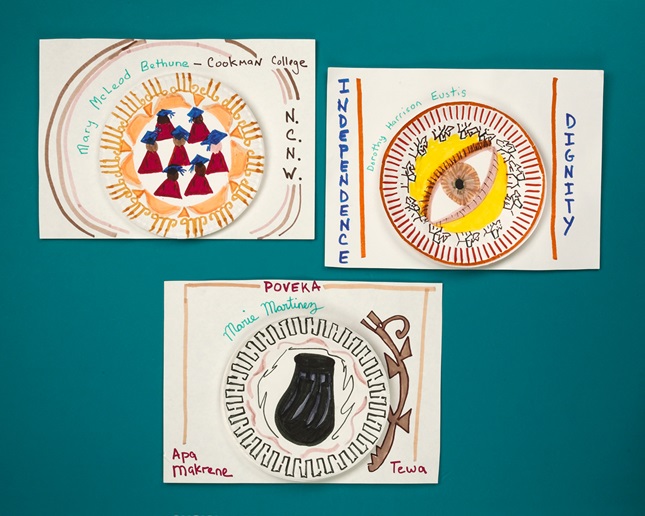
    Have students create their own dinner party settings, perhaps two or three, that feature women in history. Encourage them to represent different time periods and different fields. They can illustrate a paper plate for each honoree, write some information about her on the borders of a paper place mat, then glue the plate onto the mat.

  • Step 3

    Have students present and discuss the women they featured and why they chose them.

Standards

ARTS: Connect artistic ideas and works to/with societal, cultural, and historical context to deepen understanding.

SS: Individual Development and Identity: Describe factors important to the development of personal identity and the context of identity within families, peer or affinity groups, schools, communities, and nationalities. 

Adaptations

One of the goals of "The Dinner Party" was to bring greater awareness to notable women in history. Have students explore other artwork that sought to bring awareness to issues. Suggestions include Picasso's "Guernica" (1937) which speaks to the horrors of war and became an emblem for Spanish freedom, Jacob Lawrence's  "The Migration Series" (1940-41) which portrays the Great Migration when hundreds of thousands of African Americans moved from the rural South to the urban North, Keith Haring's "Ignorance=Fear, Silence=Death" (1989) which he created to bring awareness and prompt action regarding the AIDS epidemic, or any others.

Artivism (a portmanteau word combining "art" with "activism") is the practice of using art to spark social change. Have students create an artivism work. Encourage them to choose a cause that's meaningful to them and then create a work that might impel people to act. Suggestions include a satirical cartoon, a mock-up of a mural for the side of a building, a sculpture that could be installed in a public location, or anything else.