Skip to Main Content

Collage + Printmaking

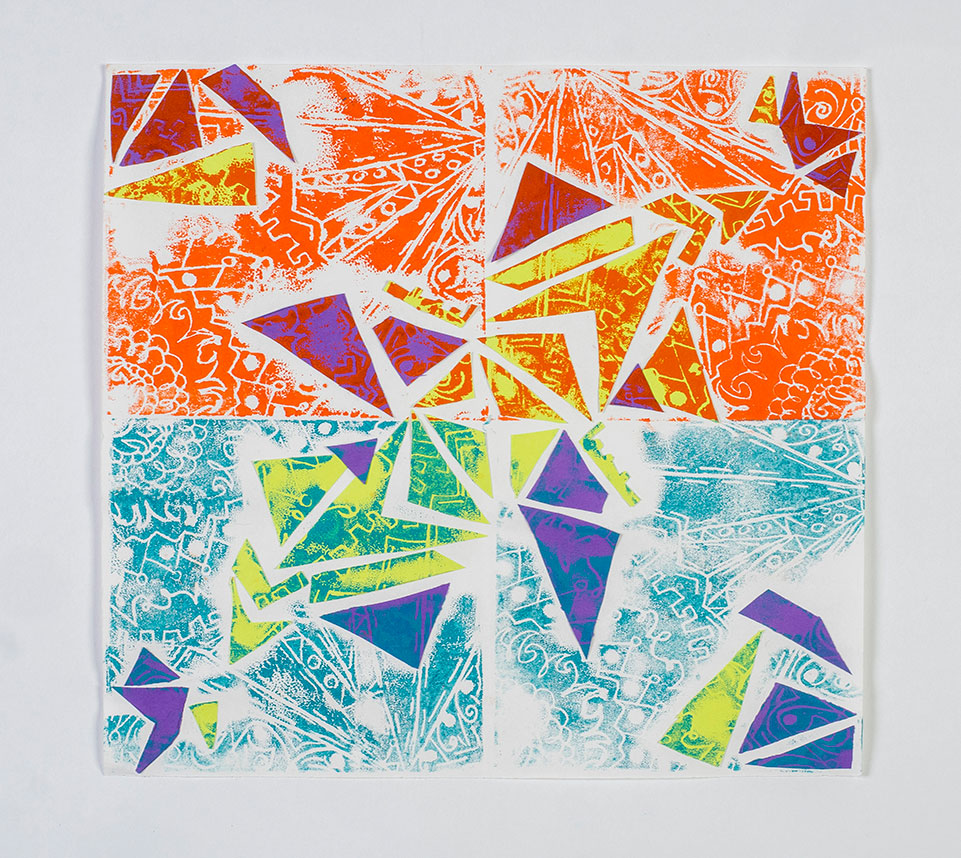
Collage, printmaking, and math converge to create a multitextured piece of artwork.

Lesson Plan

Supplies Needed

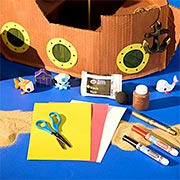
Gather all the supplies needed to bring your craft ideas to life! From paints and markers to glue and scissors, our crafts section has everything to spark creativity and make every project truly special.

Steps

  • Step 1

    Introduce students to the concept of symmetry. Explain that if a shape can be divided into two or more identical pieces it is symmetric, also known as a mirror image. To demonstrate this you could fold a piece of paper, draw half a heart at the fold, then cut it out. Open the fold to see that the two sides of the heart are mirror images. The fold is the line of symmetry. If two sides are not equal they are asymmetric.

  • Step 2

    Have students cut shapes out of heavy paper. They can choose to make them symmetrical or asymmetrical.

  • Step 3

    For printmaking, have the students make etchings into recycled foam plates (or recycled foam trays) using a sharpened pencil or another pointy object. Next have them glue the variety of shapes they created into patterns onto their foam etched collage. Spread paint smoothly onto the etched foam plate and the shapes they had glued onto it as a collage. They can spread the paint using a brayer or paintbrush. Then for the print making experience, they will press paper onto the etched foam plate collage firmly and evenly to create a monoprint. They might want to use a ruler, the palms of their hands, or a rolling pin for this step. They can apply more paint and continue to make more prints from the etched base.

Standards

MATH: Create models that demonstrate math concepts and attend to precision.

ARTS: Explore and invent art-making techniques and approaches.

Adaptations

Create a collaborative collage. Combine four foam plates that students have etched and glued geometric shapes onto. Use a large piece of paper to capture this full-size print. Create four prints, one for each contributing artist.

Have students use protractors to measure the angles of the geometric shapes and patterns found in their prints.