Skip to Main Content

Colorful Symmetry

Symmetry is all around us. Students will explore various examples of symmetry and then create a colorful and symmetric work of art.

Lesson Plan

Supplies Needed

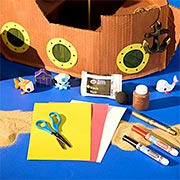
Gather all the supplies needed to bring your craft ideas to life! From paints and markers to glue and scissors, our crafts section has everything to spark creativity and make every project truly special.

Steps

  • Step 1

    Review the concept of symmetry with the class. There are four main types: reflectional (where one half is a mirror image of the other half), rotational or radial (where a shape looks the same after being rotated), translational (where a shape can be moved without changing its appearance) and glide reflectional (where a figure looks like the original when it is reflected over a line and translated at a given distance).

  • Step 2

    Have students look for and think of real-life examples of symmetry. Butterflies, hearts, and faces might come to mind for reflectional. A circlular clock is an example of radial/rotational, An example of translational symmetry is an elevator going up and down but not changing shape. An example of glide symmetry would be a set of footsteps in the sand, etc.

  • Step 3

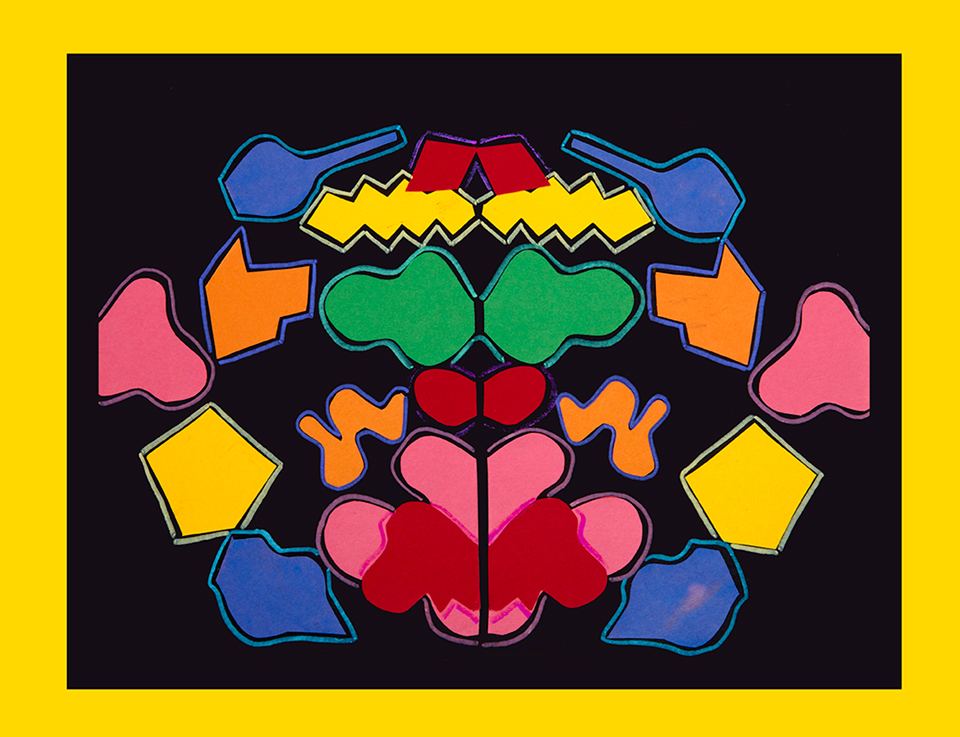
    Symmetry in various forms is also an element in art. Ask students to create a colorful symmetrical collage. They can create reflectional examples by folding pieces of construction paper in half, drawing a shape along the fold, then cutting it out. When they unfold it they will have a symmetrical shape. Have them make several of these in various colors and sizes. Then have them cut the shapes in half and arrange them symmetrically on black construction paper that has been folded down the middle then unfolded. They can embellish the collage by outlining the shapes using oil pastels.

  • Step 4

    Have students present their art and point out the points and types of symmetry.

Standards

MATH: Analyze, compare, create, and compose math ideas using written, oral, and drawn lines, shapes, forms, and patterns.  

MATH: Look for and create constructed or natural structures and patterns. 

Adaptations

Have students explore the life and work of M.C. Escher (1898-1972), a Dutch artist whose art was inspired by mathematics. Many of his works feature mathematical concepts such as impossible objects, exploration of infinity, tessellations, and symmetry. Ask them to look at images of his "Symmetry Drawing" (1948), "Liberation" (1955), "Snakes" (1969), or any others.

Read a book such as "Grandfather Tang's Story" by Ann Tompert and Robert Andrew Parker, "Seeing Symmetry" by Loreen Leedy, or "Pythagoras and the Ratios" by Julie Ellis and Phyllis Hornung Peacock. Discuss the mathematical concepts in each.