Skip to Main Content

Geo-Globe

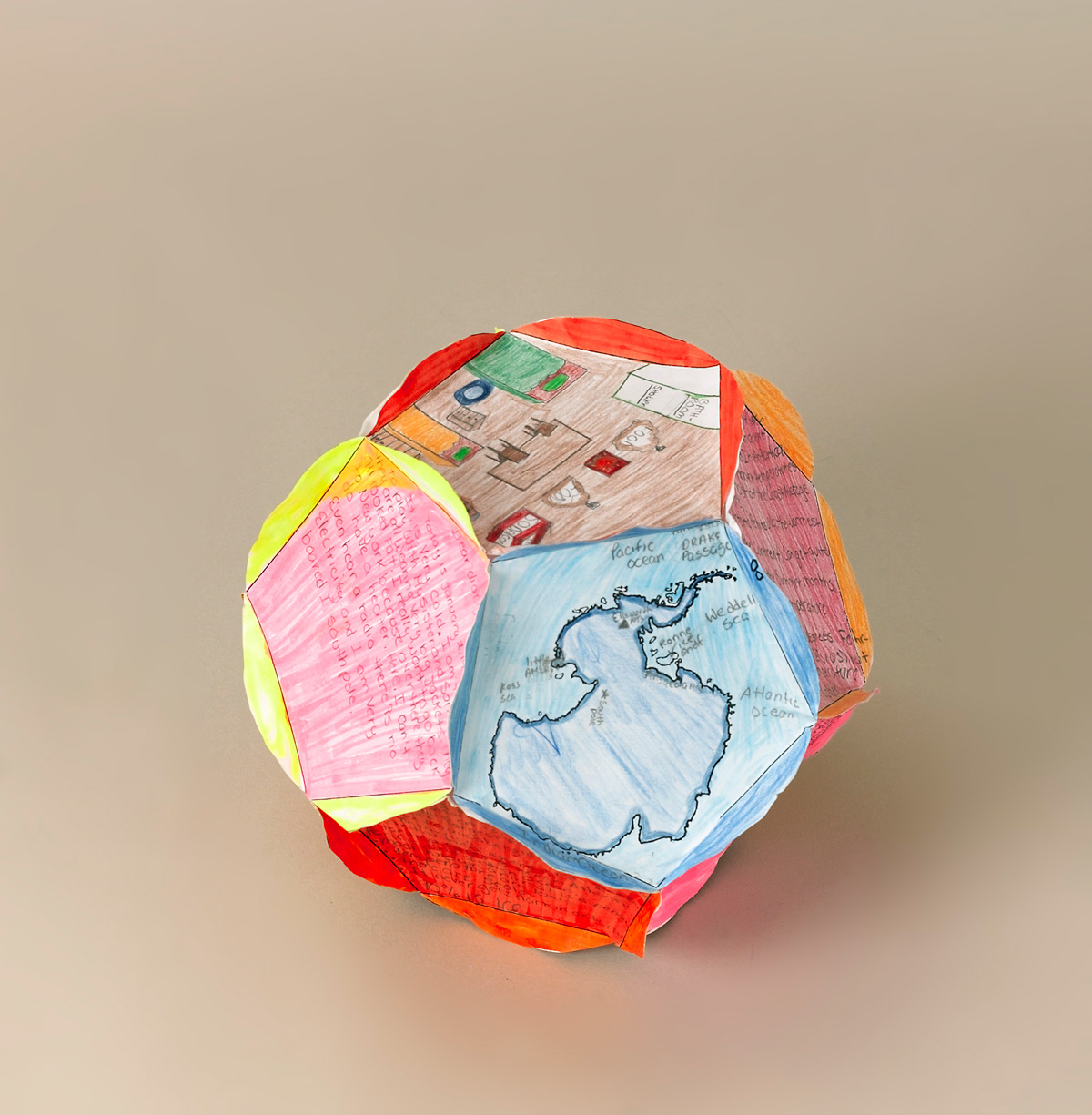
Students will create a 12-sided 3-D globe to display information about one of the Earth's continents.

Lesson Plan

Supplies Needed

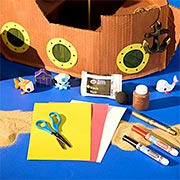
Gather all the supplies needed to bring your craft ideas to life! From paints and markers to glue and scissors, our crafts section has everything to spark creativity and make every project truly special.

Steps

  • Step 1

    Have students choose a continent to research. Ask them to learn about the countries that are located there and some facts about the people, languages, agriculture, wildlife, etc. Tell them they will be organizing some illustrations and facts on a dodecahedron, a 12-sided 3-D shape.

  • Step 2

    To create the globe have students draw 12 circles of equal size (perhaps 5"-6" in diameter). Within each circle have them draw a pentagon, with each point of the pentagon touching the rim of the circle, and then cut out the circles. Now ask them to decorate each area within the pentagon with an illustration (perhaps a map of the continent or a point of interest located there) or some facts about the continent.

  • Step 3

    To assemble their dodecahedron globe ask students to fold the five lines of the pentagon on each circle upward. Then have them begin attaching the circles together by gluing the flaps together with the illustrations and writing facing outward.

  • Step 4

    Have students display their geo-globes and talk about some of the facts they learned about the continent they chose.

Standards

MATH: Create models that demonstrate math concepts and attend to precision.

SS: People, Places, and Environments: Use maps and other geographic representations, geospatial technologies, and spatial thinking to acquire, understand, and communicate information.

Adaptations

We now have seven continents, but once there was only one: Pangaea. Have students learn about this supercontinent, which as of 250 million years ago was still one land mass but then began to be ripped apart by geological forces that shaped the continents as we now know them today.

Have students investigate the career of a geographer, a person who studies the Earth's physical and human characteristics and the relationships between them. How does someone become a geographer? What are some of their duties and responsibilities? What are some of the subspecialties (physical geographers, urban geographers, economic geographers, etc.)?