Skip to Main Content

Gravity in Motion

Why does a dropped ball hit the ground faster than a dropped feather? Students will learn about gravity and air resistance and create objects that will float through the air.

Lesson Plan

Supplies Needed

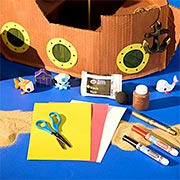
Gather all the supplies needed to bring your craft ideas to life! From paints and markers to glue and scissors, our crafts section has everything to spark creativity and make every project truly special.

Steps

  • Step 1

    What goes up must come down, and if you throw something in the air the gravitational pull will eventually cause it to hit the ground. But the speed of descent is impacted by air resistance, also called drag. Have students investigate the effect of weight and air on falling objects. Ask them to think about examples of air resistance in real life, such as parachutes, paper airplanes, falling leaves, etc. There is a great short video for children produced by the National Air and Space Museum demonstrating and explaining the principle: (www.howthingsfly.si.edu/media/weight-0).

  • Step 2

    Have students create objects to watch the effects of air resistance. Ask them to cut a piece of paper into four strips across the width of the paper and put one of the strips aside for test purposes. Then have them fold the three remaining strips in half width-wise. Open the fold and cut down the center of the strip lengthwise almost to the fold, making two flaps for the top. Next have them go to the bottom (the part that is not yet cut) and remove two sides, leaving a center strip that will be the tail. (The tail would be approximately 1/3 of the size of the top, centered in the middle.) Take that tail piece and fold up 1/3 of the bottom tail to make it into a small flap.

  • Step 3

    Students can now decorate all four pieces that will later be put into flight. When both sides of these pieces are colorful, have the students throw their pieces into the air starting with the uncut test strip. Use a timer to measure how long it takes for that to come down to the ground. Then have them throw the folded strips into the air, one at a time, and use the timer to measure how long their descents took. Did the cut pieces move differently from the test strip? Did they fall faster or slower? Have students contemplate and explain the reasons behind the flight of the pieces.

Standards

SCI: Ask questions about the features of phenomena observed and conclusions drawn from investigations or models. 

SCI: Make observations and measurements to identify properties and patterns.  

SCI: Develop a model using an example to describe a scientific principle. 

Adaptations

Extend the lesson about air resistance to learn about thrust and propulsion and why airplanes can stay in the air. There is another good video for children about this by the National Air and Space Museum: www.howthingsfly.si.edu/media/thrust-propellers

Have students learn some fun facts about parachutes. Who invented it and when? In what year was the first successful parachute jump? What is the highest jump on record?