Skip to Main Content

Which Doesn't Belong?

Children will learn basic math skills as they play a game involving similarities and differences.

Lesson Plan

Supplies Needed

Gather all the supplies needed to bring your craft ideas to life! From paints and markers to glue and scissors, our crafts section has everything to spark creativity and make every project truly special.

  • Dry Erase Board

Steps

  • Step 1

    Learning to group, sort, and compare objects is a fundamental math skill that helps other areas a well, such as problem solving and memory skills. Have children think of items that can be grouped in different ways. Ask them to come up with several different groups.

  • Step 2

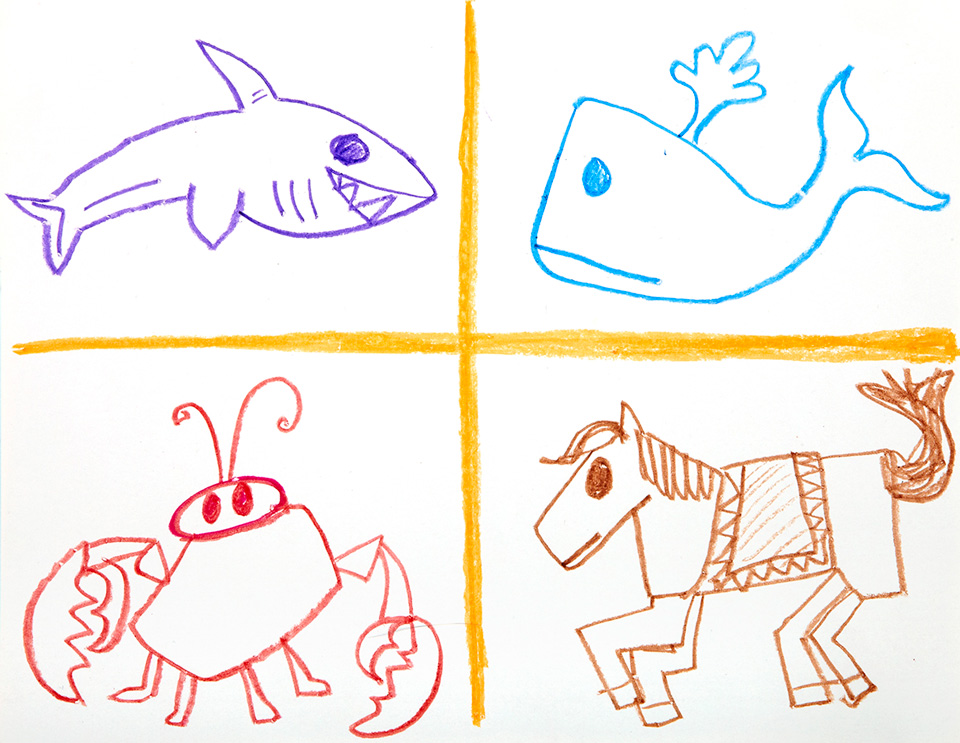
    Ask children to create a "Which one doesn't belong?" game. Have them use dry erase crayons to draw four items on a white board, three that belong together in some form of grouping and one that doesn't. Then ask classmates to decide which one one doesn't belong and the group feature that connects the others.

  • Step 3

    The benefit of using dry erase crayons is that children could quickly remove one of the objects and add another replacement to form another type of group. For example, looking at the example art, ocean dwellers could represent the group of three, and the horse doesn't belong. But if the whale and fish were blue and the the horse was erased and replaced with a blue car, the unifying group could be the color blue, and the crab wouldn't belong.

  • Step 4

    When each correct item has been identified, have children explain why three are alike and one doesn't belong in the group.

Standards

MATH: Analyze, compare, create, and compose math ideas using written, oral, and drawn lines, shapes, forms, and patterns. 

MATH: Describe, compare, quantify, and classify objects by attributes. Sort objects into categories. 

Adaptations

Read a book such as "A Pair of Socks" by Stuart J. Murphy and Lois Ehlert or "Five Creatures" by Emily Jenkins and Tomek Bogacki, both of which deal with comparisons.

Challenge students to think of different ways to regroup items. For example, crayons, pencils, books, and tissues are all school items; crayons, pencils, markers, and paints are all used for art; books, notebooks, and lunch boxes are all rectangular, etc.